On September 25th, 1066, a single English arrow found its mark in a muddy Yorkshire field, and with it, an entire age died. The man who fell that morning stood seven feet tall and bore scars from Jerusalem to Sicily. He had served Byzantine emperors, survived shipwrecks in the Black Sea, and carved his name into the marble of Hagia Sophia itself. His death would mark the end of three centuries of Viking terror that had shaped medieval Europe. But Harald Hardrada—"Hard Ruler"—had never expected to meet his end in a place as unremarkable as Stamford Bridge.
The irony was exquisite. The most feared warrior in Europe, a man who had conquered across three continents, would breathe his last breath not in some epic siege or legendary duel, but in what amounted to a surprise attack by an English army that had force-marched 185 miles in just four days. The Vikings had come expecting easy plunder. Instead, they found their Ragnarök.
The Making of a Legend: From Exile to the Holy Land
Harald's story begins not with triumph, but with teenage trauma. In 1030, at just fifteen years old, he fought alongside his half-brother King Olaf II at the Battle of Stiklestad in Norway. When Olaf fell and their army shattered, young Harald took an axe wound that left him scarred and exiled. Most defeated princes would have faded into obscurity. Harald had other plans.
He fled east to Kiev, then the glittering capital of the Rus, where Prince Yaroslav the Wise maintained a court that rivaled Constantinople itself. But even this wasn't grand enough for Harald's ambitions. In 1034, he sailed south to the greatest city in the world: Constantinople, capital of the Byzantine Empire, where the streets were paved with marble and the emperor's palace contained more wealth than entire Viking kingdoms.
Here's where Harald's story becomes almost too fantastic to believe. The Byzantines maintained an elite guard unit called the Varangians—literally "sword-brothers"—composed entirely of northern warriors. These weren't just bodyguards; they were the empire's ultimate weapon, deployed only when victory was absolutely essential. Harald didn't just join this legendary unit. Within years, he was commanding it.
For over a decade, Harald Sigurdsson became the Byzantine Empire's most effective general. He fought in Sicily, crushing Arab strongholds that had resisted imperial armies for generations. He led expeditions into the Holy Land, where his Varangians carved through Fatimid forces with methodical Viking efficiency. Contemporary sources record that he captured over eighty Arab fortresses, accumulating wealth that would make him one of the richest men in medieval Europe.
The Warrior-Poet Who Scarred Hagia Sophia
But Harald was more than just a brilliant military commander—he was that uniquely medieval figure, the warrior-poet. He composed skaldic verses celebrating his victories, sixteen of which survive today. One boasts: "We fed the wolves in Sicily, and in Jerusalem the young eagles screamed over corpses." This wasn't mere poetry; it was a résumé written in blood and verse.
The most audacious story about Harald's Constantinople years involves Hagia Sophia, the greatest cathedral in Christendom. According to Icelandic sagas, Harald and his Varangian companions carved their names into the marble balustrades of the great church. Remarkably, when archaeologists examined Hagia Sophia in the 20th century, they found runic inscriptions on the upper galleries, including one that may read "Halfdan carved these runes." While we can't prove Harald himself wielded the knife, the idea that Viking mercenaries casually defaced one of history's architectural masterpieces perfectly captures their irreverent confidence.
By 1042, Harald had accumulated enough wealth to fund his own kingdom and enough military reputation to terrify his enemies before battle even began. When political changes in Constantinople made his position precarious, he executed one of history's most daring escapes, allegedly damaging the great chain that protected Constantinople's harbor as he fled with his followers and their accumulated treasure.
The Thunderbolt of the North Returns Home
Harald's return to Norway in 1045 was like a thunderbolt striking the medieval world. The teenage exile had become something unprecedented: a Viking who understood not just raiding and pillaging, but empire. He brought Byzantine gold, Mediterranean military techniques, and perhaps most importantly, a strategic vision that extended far beyond traditional Viking horizons.
Within months, he had forced his nephew Magnus to share the Norwegian throne. When Magnus died the following year, Harald became sole king of Norway. But ruling one kingdom could never satisfy a man who had commanded armies from Sicily to Syria. Harald spent the next two decades transforming Norway into the most formidable military power in Northern Europe, while launching increasingly ambitious campaigns against Denmark.
His nickname "Hardrada"—"Hard Ruler"—was earned through relentless warfare and political cunning that made previous Viking kings seem like mere pirates. Harald understood something his predecessors had missed: the age of simple raiding was ending. The future belonged to those who could think like emperors.
By 1066, Harald controlled the most professional Viking military machine ever assembled. His personal guard had trained in the Byzantine Empire's sophisticated tactics. His fleet was the largest Scandinavia had ever seen. When civil war erupted in England following Edward the Confessor's death, Harald saw his moment to claim a throne worthy of his abilities.
The Perfect Storm: Three Kings, One Crown
The year 1066 created a perfect storm of ambition that would reshape European history. When Edward the Confessor died childless in January, three men claimed the English crown: Harold Godwinson (crowned by the English nobles), William of Normandy (claiming Edward had promised him the succession), and Harald Hardrada (asserting rights through previous agreements with earlier English kings).
What followed was a deadly game of medieval chess played across the North Sea. Harald forged an alliance with Harold Godwinson's exiled brother Tostig, assembling a fleet of 300 longships—the largest Viking armada in a generation. In September 1066, this massive force sailed up the Humber River, crushing English resistance at Fulford Gate and capturing York itself.
For a brief moment, it seemed the Viking Age might have one final, glorious chapter. Harald's army controlled northern England. William's invasion fleet waited for favorable winds across the Channel. Harold Godwinson faced the ultimate strategic nightmare: enemies approaching from two directions, either one capable of destroying his kingdom.
Harald Hardrada made camp at Stamford Bridge, just outside York, and prepared to receive English submission. He had every reason for confidence. His army was veteran and well-supplied. The English had been decisively beaten at Fulford. Harold Godwinson was supposedly still in London, 200 miles south, waiting for William's invasion.
He was wrong.
The Morning That Ended an Age
Harold Godwinson's forced march from London to Yorkshire ranks among history's most decisive military movements. In just four days, his army covered 185 miles—an almost superhuman pace that left Harald Hardrada completely unprepared for what struck his camp on the morning of September 25th.
The Battle of Stamford Bridge began with individual combat that could have emerged from a Norse saga. A single Viking berserker held the narrow bridge against the entire English army, wielding a massive battle-axe and killing dozens of enemies before an English soldier floated beneath the bridge in a barrel and speared him from below. It was a scene worthy of Valhalla itself.
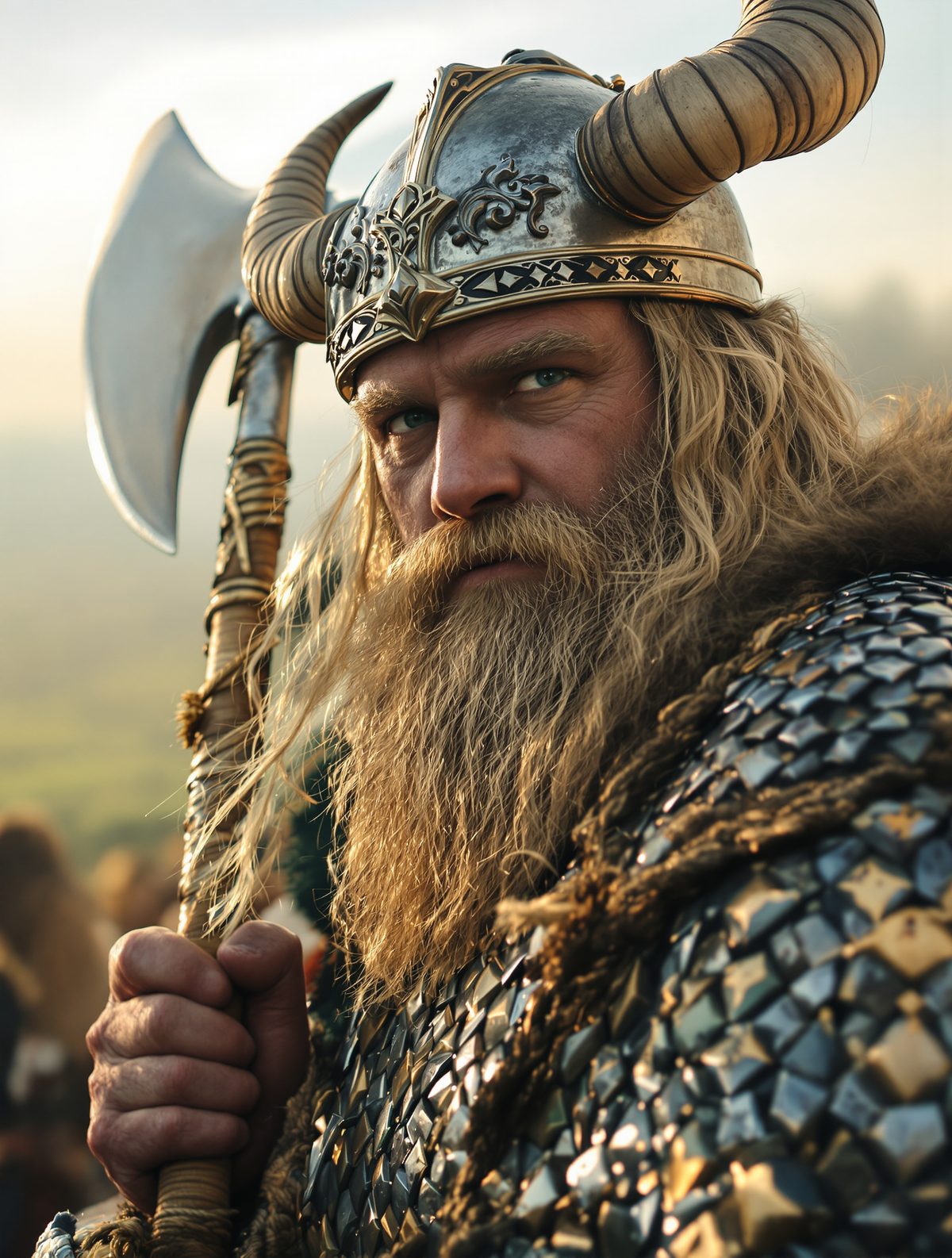
But when the English army finally crossed, medieval reality crushed Viking legend. Harald's men were caught unprepared, many without armor in the late September heat. Harald himself fought in the front ranks, towering above other warriors, his golden banner "Land-Waster" visible across the battlefield.
Then came the moment that changed everything. An English arrow, fired by an unknown archer from the ranks of Harold Godwinson's army, found its target. Harald Hardrada, who had survived battles from Jerusalem to Sicily, who had commanded the Byzantine Emperor's elite guard, who had seemed almost supernaturally invincible, fell dead in a muddy Yorkshire field.
The psychological impact was immediate and devastating. The Vikings had followed Harald not just as a king, but as a figure approaching mythology. His death shattered their morale completely. The English army rolled over the remaining resistance, killing Tostig and destroying the Viking army so thoroughly that only 24 of the original 300 ships were needed to carry the survivors home to Norway.
The Last Echo of Thor's Hammer
Three weeks later, Harold Godwinson would die at Hastings, and William the Conqueror would begin reshaping England into a Norman kingdom. But Harald Hardrada's death at Stamford Bridge marked something more profound than one king's defeat. It marked the end of the Viking Age itself.
For three centuries, the sight of dragon-prowed longships had terrorized European coastlines from Ireland to Constantinople. Viking warriors had carved out kingdoms from Iceland to Sicily, served as mercenaries for Byzantine emperors and Frankish kings, and fundamentally shaped medieval European development through their mixture of trading, raiding, and settling.
Harald Hardrada represented the absolute pinnacle of this tradition—a warrior-king who combined traditional Viking ferocity with sophisticated international experience, commanding resources and loyalty that earlier generations could barely imagine. His death proved that even the most legendary Viking could be stopped by organized resistance and tactical surprise.
The age that died with Harald was being replaced by something fundamentally different: the medieval world of castles and heavy cavalry, of feudalism and centralized kingdoms, where professional armies loyal to territorial monarchs would dominate warfare for centuries to come.
Perhaps most remarkably, Harald Hardrada's extraordinary life—spanning three continents, multiple empires, and cultures from Byzantine Christianity to Norse paganism—shows us how interconnected the medieval world really was. This was no "Dark Age" of isolation and ignorance, but a dynamic era where a Norwegian teenager could become a Byzantine general, accumulate Mediterranean wealth, and return home to launch an invasion of England that involved political alliances stretching from Kiev to Normandy.
In our own age of globalization, Harald Hardrada's career offers a strange mirror: proof that ambition, adaptability, and strategic vision have always been able to transcend cultural boundaries—and that even the most successful careers can end with shocking suddenness when ambition finally overreaches reality.