
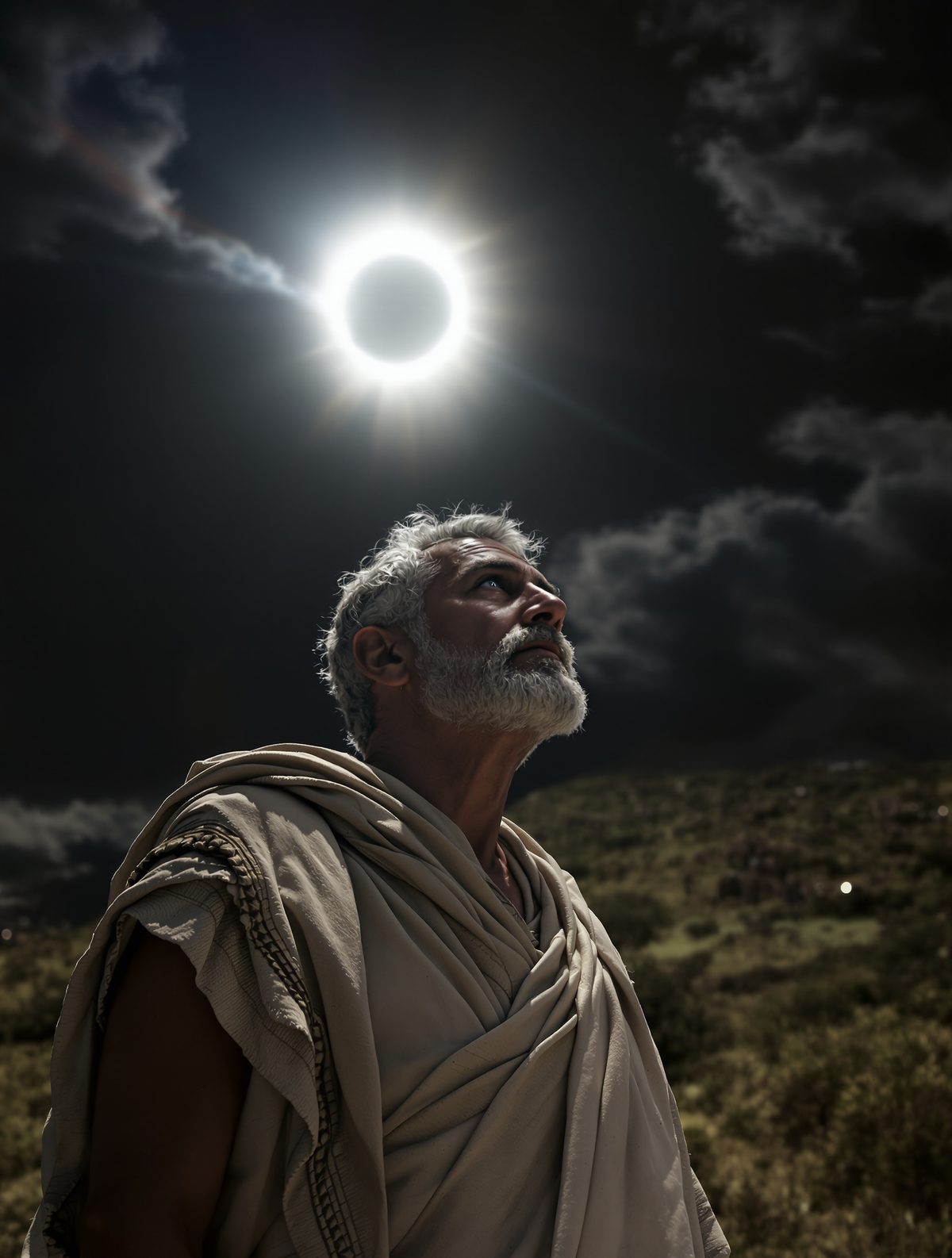
The sun was climbing toward its zenith on May 28th, 585 BC, when thousands of warriors raised their bronze-tipped spears and prepared to die. Across the dusty plains of what is now Turkey, two mighty armies faced each other in what both sides knew would be a decisive battle. The Lydians, masters of cavalry warfare, had ridden west from their golden capital of Sardis. The Medes, fierce mountain fighters who had helped topple the Assyrian Empire, had marched hundreds of miles from their strongholds in modern-day Iran.
For six brutal years, these two powers had clashed repeatedly, leaving battlefields littered with the dead and entire regions devastated by war. But neither King Alyattes of Lydia nor King Cyaxares of the Medes could have imagined that their final confrontation would end not with victory or defeat, but with a cosmic intervention that would send both armies fleeing in supernatural terror.
As the warriors began their deadly advance, something impossible began to happen. A shadow started creeping across the face of the sun. Within minutes, day transformed into an eerie twilight, then into complete darkness. Stars appeared in what should have been the afternoon sky. The temperature dropped. Animals fell silent. And in the absolute darkness of totality, thousands of battle-hardened soldiers threw down their weapons and ran.
But 600 miles away in the Greek city of Miletus, one man was not surprised at all. Thales, a philosopher and mathematician, had calculated this moment with stunning precision—and he had just changed the course of history.
The Sage of Miletus: More Than Just a Thinker
Thales of Miletus wasn't your typical ancient Greek philosopher pondering abstract concepts in marble halls. Born around 624 BC in the bustling port city of Miletus on the coast of modern-day Turkey, he was a practical man who applied his brilliant mind to solving real-world problems. While his contemporaries attributed natural phenomena to the whims of angry gods, Thales searched for rational, mathematical explanations.
This revolutionary thinker had already made his fortune through clever business ventures—including a legendary scheme where he cornered the olive press market after predicting a bumper olive harvest. But his true passion lay in understanding the cosmos. He studied geometry with Egyptian priests, learned astronomical techniques from Babylonian scholars, and developed mathematical theorems that would bear his name for millennia.
What made Thales truly extraordinary was his radical belief that the universe operated according to discoverable laws, not divine caprice. When earthquakes struck, he theorized that the earth floated on water and trembled when waves disturbed it—wrong, but brilliantly logical for his time. When he gazed at the night sky, he didn't see mythological figures but celestial clockwork that could be calculated and predicted.
And sometime around 590 BC, using astronomical records and mathematical calculations that historians still debate today, Thales made a prediction that would soon shake two kingdoms: on a specific day in the near future, the sun would disappear completely from the sky.
Six Years of Blood: The Lydian-Median War
While Thales refined his calculations, the ancient world was convulsing with warfare. The Lydians and Medes represented two of the era's great powers, and their conflict was reshaping the map of the ancient Near East. King Alyattes of Lydia ruled over the wealthy western regions of Anatolia, where his people had revolutionized commerce by minting the world's first coins from electrum, a natural alloy of gold and silver found in local rivers.
The Median Empire, meanwhile, controlled vast territories stretching from the Zagros Mountains to the edges of Central Asia. Under King Cyaxares, they had become the dominant force in the former Assyrian territories, commanding fierce loyalty from dozens of subject peoples and maintaining one of the era's most formidable military machines.
What sparked their war remains unclear—perhaps disputes over trade routes, territorial boundaries, or simple imperial ambition. But the conflict that began around 590 BC quickly escalated into a brutal struggle for regional supremacy. Ancient sources describe devastating campaigns where entire cities were razed, populations enslaved, and fertile valleys transformed into wastelands.
The warfare followed a grinding pattern: massive armies would march for weeks, clash in titanic battles that left thousands dead, then retreat to lick their wounds before the cycle began anew. Neither side could deliver a knockout blow, but neither could afford to appear weak by seeking peace. By 585 BC, both kingdoms were exhausted, their treasuries drained and their populations weary of endless warfare.
The Day the Sun Died
On that fateful morning of May 28th, 585 BC, both armies had assembled for what promised to be the largest and most decisive battle yet. The location, somewhere in the borderlands between the two empires, had been chosen with care—flat terrain suitable for cavalry charges, access to water sources, and clear sight lines for commanders to coordinate their forces.
As the sun climbed higher, tens of thousands of warriors prepared for combat with grim efficiency. Lydian horsemen checked their gear and whispered prayers to their gods. Median infantry, many bearing scars from previous battles, formed their battle lines with disciplined precision. The air thrummed with tension as commanders shouted final orders and war drums began their ominous rhythm.
Then, just as the armies began their advance, the impossible began. At first, it might have seemed like a cloud passing over the sun—nothing unusual for warriors accustomed to fighting in all weather. But this shadow was different. It crept across the solar disk with unnatural precision, eating away at the light bit by bit.
Within minutes, an otherworldly twilight settled over the battlefield. The temperature dropped noticeably. Birds stopped singing. Horses began to prance nervously, sensing something their riders couldn't yet comprehend. And still, the shadow continued its relentless advance across the sun's face.
When totality arrived, the effect was beyond anything these ancient warriors could have imagined. Day became night in moments. Stars appeared in the darkened sky. The sun's corona blazed around the black disk of the moon like some celestial crown of fire. And in that moment of absolute cosmic drama, two armies forgot their earthly disputes and fled in supernatural terror.
The Peace That Fell From Heaven
The eclipse lasted only minutes, but its psychological impact was instantaneous and permanent. To warriors who lived in a world where eclipses were harbingers of divine wrath or cosmic catastrophe, this celestial intervention carried an unmistakable message: the gods themselves opposed this war.
Both armies retreated in chaos, their commanders abandoning all thought of battle in the face of what seemed like supernatural condemnation. Within hours, word was racing back to both capitals that heaven itself had intervened to stop the fighting. Rather than regroup for another assault, both kings interpreted the eclipse as a divine command to make peace.
The subsequent negotiations, mediated by the kings of Babylon and Cilicia, resulted in a comprehensive peace treaty that established clear borders, arranged a diplomatic marriage between the royal families, and created a lasting alliance between the two former enemies. The war that had consumed six years and countless lives ended not with victory or defeat, but with a mutual recognition that some forces transcend human ambition.
But the most remarkable aspect of this story isn't the eclipse itself—it's that one man had seen it coming. While two armies fled in terror from an "impossible" event, Thales of Miletus had calculated its arrival with stunning accuracy, demonstrating the power of rational inquiry over superstition and fear.
The Eclipse That Changed Everything
The eclipse of 585 BC represents far more than an interesting historical footnote. It marks a pivotal moment in human intellectual development—the first recorded instance of someone using mathematical reasoning to predict a natural phenomenon with precision, then seeing that prediction vindicated by events.
Modern astronomers have confirmed that a total solar eclipse indeed occurred on May 28th, 585 BC, visible from the region where ancient sources place this battle. The fact that Thales could calculate its timing, despite working with primitive instruments and limited astronomical data, speaks to both his mathematical genius and his revolutionary approach to understanding the natural world.
His success helped establish the foundations of what we now call the scientific method—the radical idea that natural phenomena follow discoverable laws rather than the arbitrary whims of supernatural forces. While his contemporaries saw the eclipse as proof of divine power, Thales saw it as evidence of cosmic order that human reason could comprehend and predict.
The peace treaty that emerged from this celestial intervention lasted for decades and helped stabilize the entire region. The Lydian-Median alliance proved strong enough that when Cyrus the Great of Persia later conquered both kingdoms, they fell not to internal warfare but to an external force neither had anticipated.
Today, as we face our own global challenges, Thales' story offers a powerful reminder that knowledge and rational thinking can triumph over fear and superstition. In a world where scientific literacy often seems under threat, perhaps we need more people willing to study the cosmos with the patience and precision of that ancient Greek philosopher—people who understand that the greatest power isn't in the weapons we wield, but in the knowledge we choose to pursue.
The sun that went dark over an ancient battlefield eventually returned to illuminate a world forever changed—not just by the peace it created, but by the proof it offered that human reason could unlock the secrets of the universe itself.