
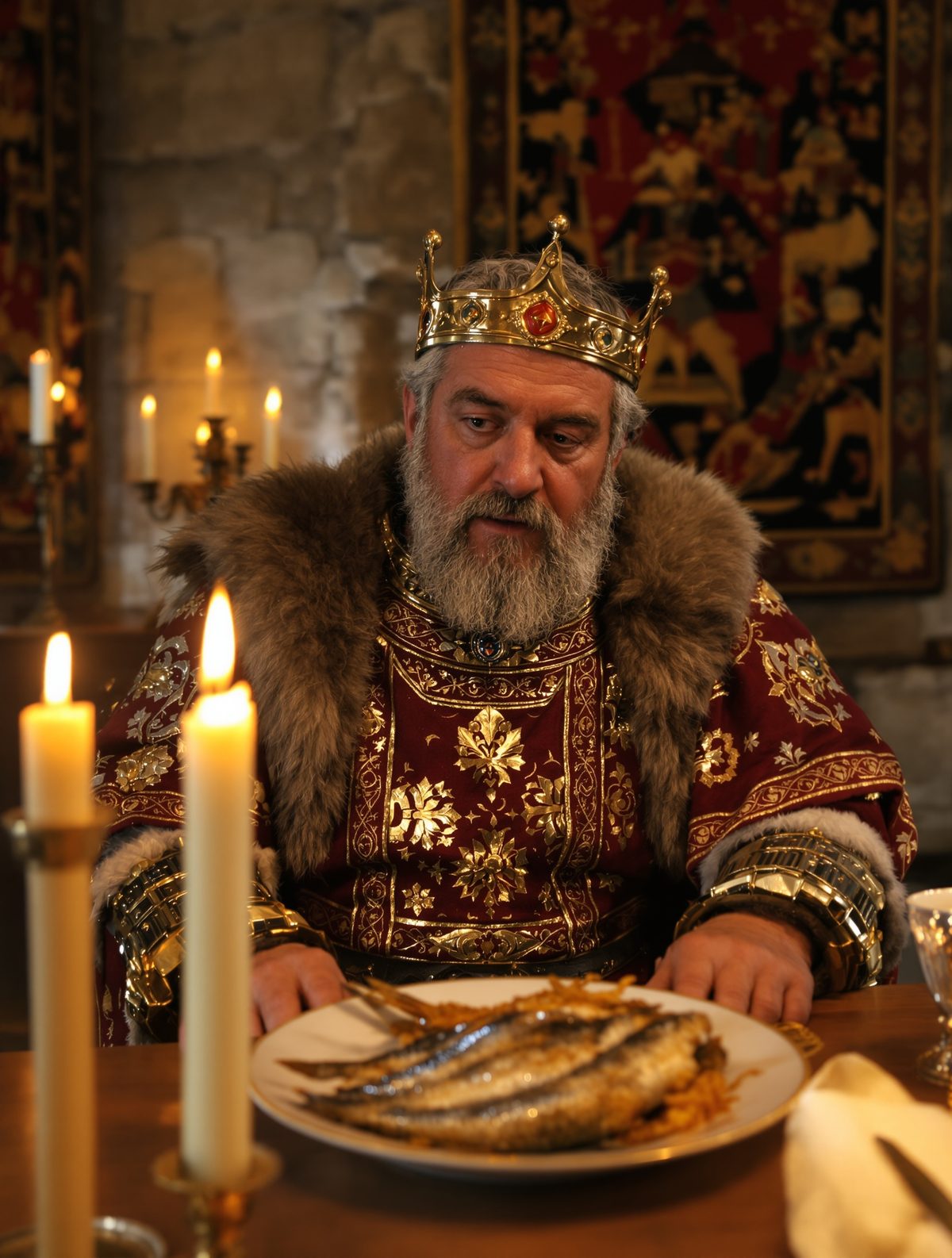
Picture this: the most powerful man in England, a king who conquered nations and crushed rebellions, lying on his deathbed not from a sword wound or poison, but from his inability to resist a plate of slimy, eel-like fish. King Henry I of England had survived thirty-five years of medieval warfare, political assassination attempts, and family betrayals, only to be brought down by what medieval chroniclers euphemistically called a "surfeit of lampreys." It was December 1135, and the king who could conquer anything couldn't conquer his own appetite.
This isn't just a quirky footnote in history—it's the story of how one man's culinary obsession changed the course of English history forever. Because when Henry I died from his lamprey feast, he left behind no male heir, setting the stage for a brutal civil war that would tear England apart for nearly two decades.
The Warrior King's Fatal Weakness
Henry I wasn't supposed to be king at all. Born around 1068 as the youngest son of William the Conqueror, he was meant to inherit money while his older brothers got the real prizes—Robert received Normandy, and William Rufus got England. But Henry was patient, cunning, and ruthless. When William Rufus died in a mysterious hunting "accident" in 1100 (with Henry conveniently present), the youngest brother seized the throne before his older brother Robert could cross the English Channel.
For the next thirty-five years, Henry ruled with an iron fist wrapped in a velvet glove. He standardized the currency, established a sophisticated bureaucracy, and crushed his enemies with methodical precision. The Anglo-Saxon Chronicle praised him as a king who brought peace and prosperity to England. He was called "the Lion of Justice"—a man who reportedly had thieves castrated and counterfeiters' hands chopped off, yet who could also charm nobles and commoners alike.
But this formidable monarch had one weakness that everyone at court knew about: an absolutely uncontrollable craving for lampreys. Not just any fish would do—it had to be lampreys, those primitive, jawless, eel-like creatures that attached themselves to other fish like living nightmares and sucked their blood.
Medieval Delicacy or Death Sentence?
To understand just how bizarre Henry's obsession was, you need to know what lampreys actually are. These ancient creatures—literally older than dinosaurs—look like something from a horror movie. They have circular, suction-cup mouths filled with rows of razor-sharp teeth, and they feed by latching onto larger fish and boring holes through their skin to drink their blood. Medieval people knew they were weird, but they also considered them an incredible delicacy.
Lampreys were so prized that they became a form of currency. The city of Gloucester paid an annual rent to the Crown of a lamprey pie, a tradition that incredibly continues to this day. When Queen Elizabeth II celebrated her Diamond Jubilee in 2012, Gloucester still presented her with a ceremonial lamprey pie, though they had to import the lampreys from North America because British waters could no longer supply enough.
But here's what medieval doctors knew that makes Henry's story even more tragic: lampreys were dangerous. The fish are extremely rich, oily, and difficult to digest. Medieval physicians warned that eating too many could cause severe digestive distress, fever, and even death. The Anglo-Norman chronicler Henry of Huntingdon specifically noted that Henry's doctors had repeatedly warned him against eating lampreys, especially as he aged.
The king didn't care. Court records show that Henry demanded lampreys be served at royal feasts throughout the year, not just during their natural season. He had them transported in barrels of wine and salt across his kingdom. Some historians estimate that Henry consumed lampreys at least twice a week—an absolutely staggering amount of a fish that should have been an occasional treat.
The Final Feast
In late November 1135, Henry traveled to Lyons-la-Forêt in Normandy to hunt. He was 67 years old—ancient by medieval standards—and had been suffering from various ailments. His physicians had become increasingly urgent in their warnings about his dietary habits. But Henry was feeling good, the hunting was excellent, and when his cooks presented him with a fresh preparation of lampreys, the king couldn't resist.
According to the chronicler Henry of Huntingdon, who was writing just a few years after the events, Henry "ate of lampreys, though his physician had advised him against it." But this wasn't just a small portion—medieval accounts suggest the king gorged himself on an entire dish of the rich, oily fish. Other courtiers at the feast later reported that Henry seemed almost compulsive in his eating, unable to stop even when he began feeling ill.
Within hours, Henry was violently sick. Medieval accounts describe him suffering from severe digestive distress, fever, and what sounds like food poisoning or acute gastroenteritis. But this wasn't just a bad night—Henry never recovered. He lingered for about a week, growing steadily weaker, before dying on December 1, 1135.
The irony was not lost on medieval chroniclers. Here was a king who had survived the brutal politics of Norman conquest, who had won battles against overwhelming odds, who had outlived most of his contemporaries—and he died because he couldn't push away a plate of fish.
When a King's Death Changes History
Henry's death from overeating lampreys wasn't just a personal tragedy—it was a political catastrophe that plunged England into chaos. The king had lost his only legitimate son, William Aetheling, in the White Ship disaster of 1120, one of medieval England's greatest tragedies. A ship carrying the flower of Anglo-Norman nobility sank in the English Channel, taking with it not just the heir to the throne but an entire generation of nobles.
Henry had tried to solve the succession crisis by naming his daughter Matilda as his heir—something unprecedented in English history. But when Henry died unexpectedly from his lamprey feast, his nephew Stephen of Blois moved quickly to claim the throne, arguing that England couldn't be ruled by a woman.
The result was "The Anarchy"—a brutal civil war that lasted from 1135 to 1153. Matilda and Stephen fought savage campaigns across England, with the Anglo-Saxon Chronicle recording that "Christ and his saints slept" during this period. Castles were built and destroyed, entire towns were burned, and thousands died in a conflict that might never have happened if Henry had simply listened to his doctors and avoided that final plate of lampreys.
The Lamprey Legacy
The story of Henry I and his lampreys reveals something profound about power, personality, and the random nature of historical change. Here was a king who controlled every aspect of his kingdom with meticulous precision, yet couldn't control his own appetite. A man who made calculated decisions about war and peace, but couldn't calculate the risk of one more helping of his favorite dish.
Medieval people understood this irony perfectly. They saw Henry's death as a moral lesson about the dangers of gluttony and the limits of earthly power. But modern historians see something else—a reminder that history often turns on the smallest, most human moments. The course of English history was altered not by a great battle or political revolution, but by a 67-year-old man who couldn't resist his favorite meal.
Today, as we obsess over our own dietary choices and listen to our own doctors' warnings about the foods we love, Henry I's story feels strangely contemporary. We all have our lampreys—those irresistible temptations that we know aren't good for us but that we can't quite give up. The difference is that when we indulge, we don't usually plunge entire kingdoms into civil war.
The next time you ignore medical advice for the sake of something delicious, remember Henry I. Sometimes the most powerful people in history are brought down not by their enemies, but by their inability to say no to one more bite.