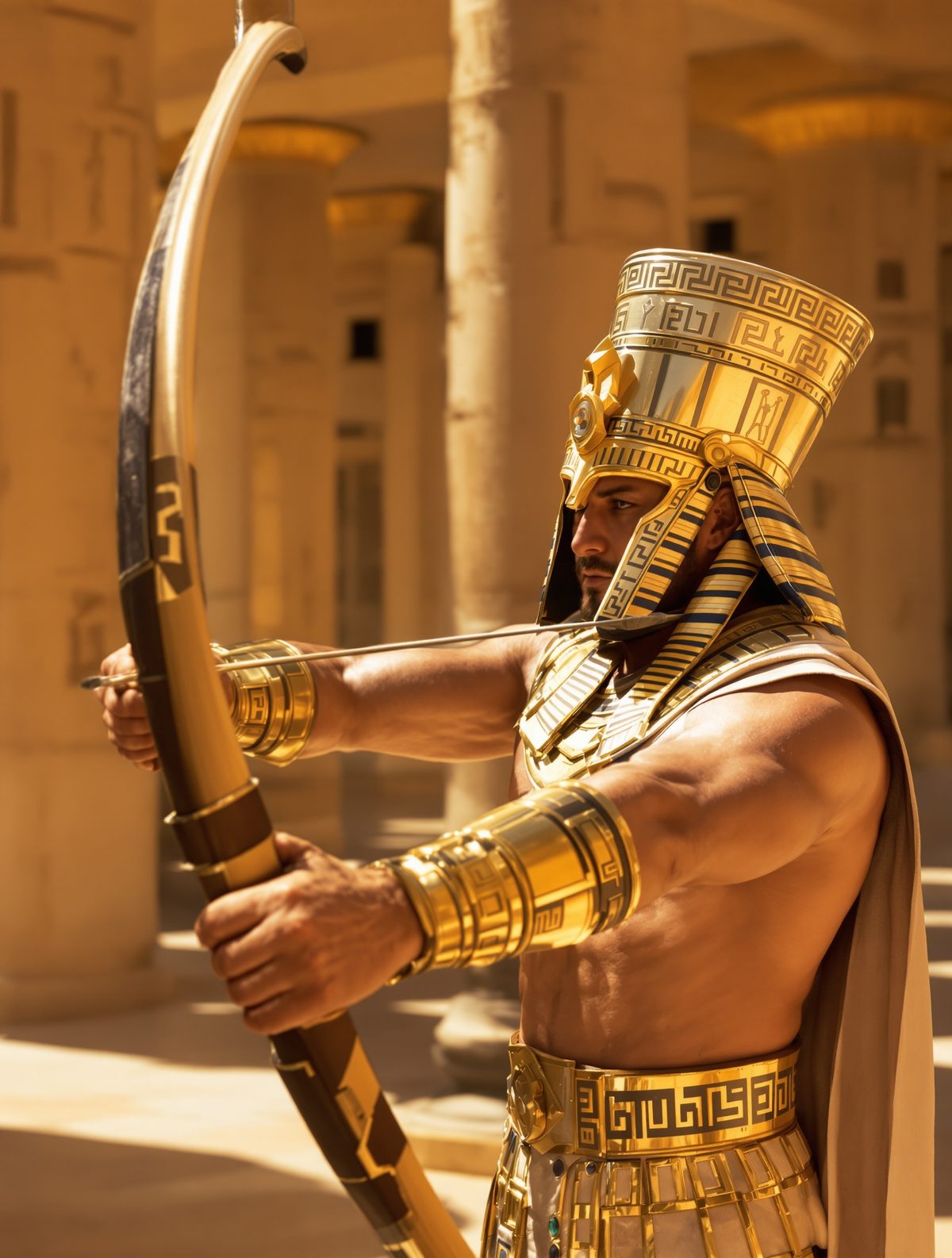
Picture this: A bronze-muscled pharaoh, reins wrapped around his waist, thunders across the desert sand in his war chariot. Without slowing, he draws his composite bow, takes aim at a gleaming copper target three fingers thick, and releases. The arrow doesn't just hit its mark—it punches clean through the metal with such force that it emerges from the other side. The crowd erupts. But this isn't Hollywood fiction. This is ancient Egypt, 1427 BC, and Pharaoh Amenhotep II just pulled off what may be history's most documented display of superhuman archery.
Most pharaohs bragged about their military conquests or architectural marvels. Amenhotep II? He had bronze commemorative plaques made celebrating his ability to turn copper targets into ancient Egyptian Swiss cheese. And here's the kicker—archaeologists believe he actually did it.
The Pharaoh Who Made Robin Hood Look Like an Amateur
Amenhotep II ruled Egypt during the height of the 18th Dynasty, when the empire stretched from Nubia to the Euphrates River. Born around 1450 BC, he inherited a kingdom already drunk on military success from his father, Thutmose III—the Napoleon of ancient Egypt. But while his father conquered through strategy and siege warfare, Amenhotep II preferred a more... theatrical approach to demonstrating Egyptian superiority.
The young pharaoh stood apart from his predecessors in more ways than royal propaganda. Ancient texts describe him as unusually tall and powerfully built, with arms "stronger than any king who had ever lived." But it wasn't just his physique that set him apart—it was his obsession with proving it. Where other pharaohs commissioned reliefs showing them smiting enemies or receiving tribute, Amenhotep II filled his monuments with detailed accounts of his athletic prowess.
The most famous of these boasts comes from a sandstone stela discovered near the Great Sphinx at Giza. The inscription, carved in hieroglyphs with the precision of a legal document, claims that the pharaoh could shoot arrows through copper targets "three palms thick" while his chariot raced at full speed. A palm in ancient Egypt measured roughly three inches, meaning these weren't thin sheets of metal—they were substantial barriers that would challenge a modern compound bow.
Bronze Bragging Rights: The Archaeological Evidence
What makes Amenhotep II's claims extraordinary isn't just their audacity—it's that he literally cast them in bronze. Multiple commemorative plaques have been discovered bearing detailed accounts of his archery demonstrations, complete with specifications about arrow types, bow construction, and target materials. These weren't casual boasts scrawled on temple walls; they were expensive, permanent records meant to preserve his achievements for eternity.
The most detailed account comes from a bronze tablet discovered at Karnak Temple. The inscription describes a demonstration performed before foreign dignitaries and Egyptian nobles at Memphis around 1420 BC. According to the text, Amenhotep II used arrows crafted from cedar wood with bronze points, shot from a composite bow "strung with sinew from the finest bulls of Kush." The targets were sheets of copper "beaten by the finest metalworkers of Thebes" and mounted on wooden frames.
But here's where it gets interesting: modern metallurgical analysis of copper artifacts from Amenhotep II's reign reveals something unexpected. The copper wasn't pure—it contained small amounts of tin and other metals that actually made it harder than pure copper, not softer. This pharaoh wasn't choosing easy targets; he was making his demonstrations more difficult, almost as if he had something to prove.
The Physics of Pharaonic Firepower
Could a human being really shoot arrows through three inches of copper? Modern archery experts have attempted to recreate Amenhotep II's feat using reconstructed ancient Egyptian composite bows. The results are... complicated.
Dr. Robert Hardy, the renowned British archer and historian, spent years studying ancient Egyptian archery techniques. His experiments with replica bows suggested that the most powerful ancient Egyptian composite bows could generate draw weights of up to 200 pounds—significantly more than most modern hunting bows. When combined with heavy bronze-tipped arrows and the mechanical advantage of shooting from a moving chariot (which adds the vehicle's momentum to the arrow's velocity), penetrating thick copper becomes theoretically possible.
The key lies in the construction of ancient Egyptian war bows. These weren't simple wooden sticks. They were sophisticated composite weapons made from layers of wood, horn, and sinew, often requiring months to cure properly. The horn provided compression strength on the belly of the bow, while sinew on the back provided tension. This combination could store and release enormous amounts of energy—energy that had to go somewhere when the arrow was released.
Even more intriguing are the arrows described in Amenhotep II's inscriptions. These weren't hunting arrows but specialized military projectiles designed for maximum penetration. Archaeological examples show bronze points shaped like elongated pyramids, specifically designed to concentrate force into the smallest possible area. When shot from a 200-pound bow by someone with exceptional strength and technique, these arrows became ancient armor-piercing ammunition.
Training a God-King: The Making of a Pharaonic Archer
How does someone develop the strength and skill to perform such feats? Ancient Egyptian texts provide tantalizing glimpses into Amenhotep II's training regimen, and it reads like something from a modern special forces manual.
Royal tutors' records describe a daily routine that began before dawn with chariot training in the desert west of Memphis. The young prince would drive his chariot at full speed across increasingly difficult terrain while shooting at targets of various materials—wood, leather, and eventually metal. But this wasn't just target practice; it was a comprehensive athletic program designed to develop the strength, coordination, and mental focus of a warrior-king.
Ancient texts describe Amenhotep II's arms as being "like the limbs of Montu," the Egyptian god of war, and claim he could draw bows that "no other man in his army, nor any ruler of a foreign land" could even string. While royal propaganda certainly inflated these claims, the consistency of the accounts across multiple sources suggests there was truth behind the hyperbole.
The pharaoh's training extended beyond archery. Inscriptions describe him rowing a boat faster than 200 oarsmen, running longer distances than his royal guards, and handling horses that "no one else dared approach." This wasn't just about being a good archer—it was about establishing divine kingship through superhuman physical prowess.
Psychological Warfare: Arrows as Diplomacy
But why make such a public spectacle of archery skills? The answer lies in the brutal realities of ancient diplomacy. Egypt's empire depended on the submission of dozens of vassal states stretching across the ancient Near East. Rebellion was always simmering beneath the surface, held in check only by fear of Egyptian military might.
Amenhotep II's archery demonstrations weren't entertainment—they were calculated displays of Egyptian technological and physical superiority. Foreign ambassadors who witnessed these feats returned home with vivid accounts of a pharaoh who could penetrate the finest armor with ease. The message was clear: if this is what their king can do with a single arrow, imagine what their army can do to your city.
Contemporary accounts from Nubian and Syrian sources confirm that news of Amenhotep II's demonstrations spread throughout the ancient world. One fragmentary Akkadian text discovered at Mari describes "the king of Egypt who shoots through metal as if it were papyrus." Another, found in the Hittite archives, warns against provoking "the archer-king whose arrows no shield can turn aside."
The psychological impact was profound. During Amenhotep II's reign, Egypt faced fewer rebellions than under his predecessors, despite controlling the same vast territory. Sometimes the most effective weapon isn't the one you use in battle—it's the one that prevents battles from happening at all.
The Legacy of an Ancient Strongman
Amenhotep II died around 1400 BC, but his reputation as history's most accomplished royal archer lived on for centuries. Later pharaohs attempted to match his feats, but none achieved the same legendary status. His mummy, discovered in 1898 in the Valley of the Kings, reveals a man who lived up to his reputation—tall, powerfully built, with arms showing the distinctive muscle development of a lifelong archer.
What makes Amenhotep II's story so compelling isn't just the impressive nature of his claimed feats—it's what they tell us about the intersection of politics, propaganda, and genuine human achievement in the ancient world. In an age when rulers were expected to be living gods, this pharaoh found a way to make divinity tangible and measurable. He didn't just claim to be superhuman; he provided quantifiable proof.
Today, as we debate the role of physical fitness and personal achievement in leadership, Amenhotep II's bronze plaques remind us that the connection between individual prowess and political authority is nothing new. Perhaps that's why his story still resonates—in a world of spin and carefully crafted image management, there's something refreshing about a leader who was willing to put his reputation on the line, one arrow at a time.
The next time you see an Olympic archer draw their bow, remember: they're participating in a tradition that stretches back nearly 3,500 years to a pharaoh who turned marksmanship into statecraft, one impossible shot at a time.