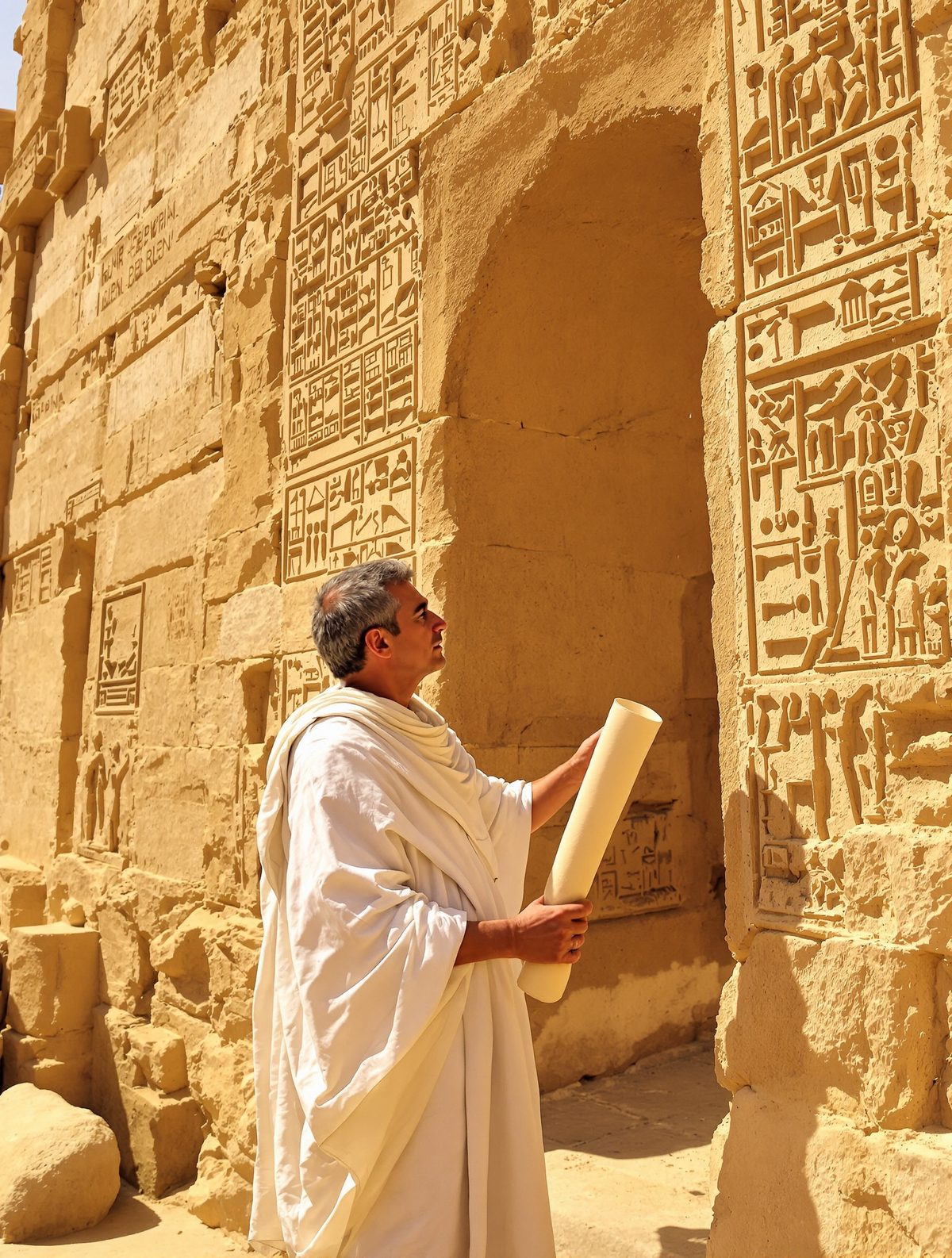
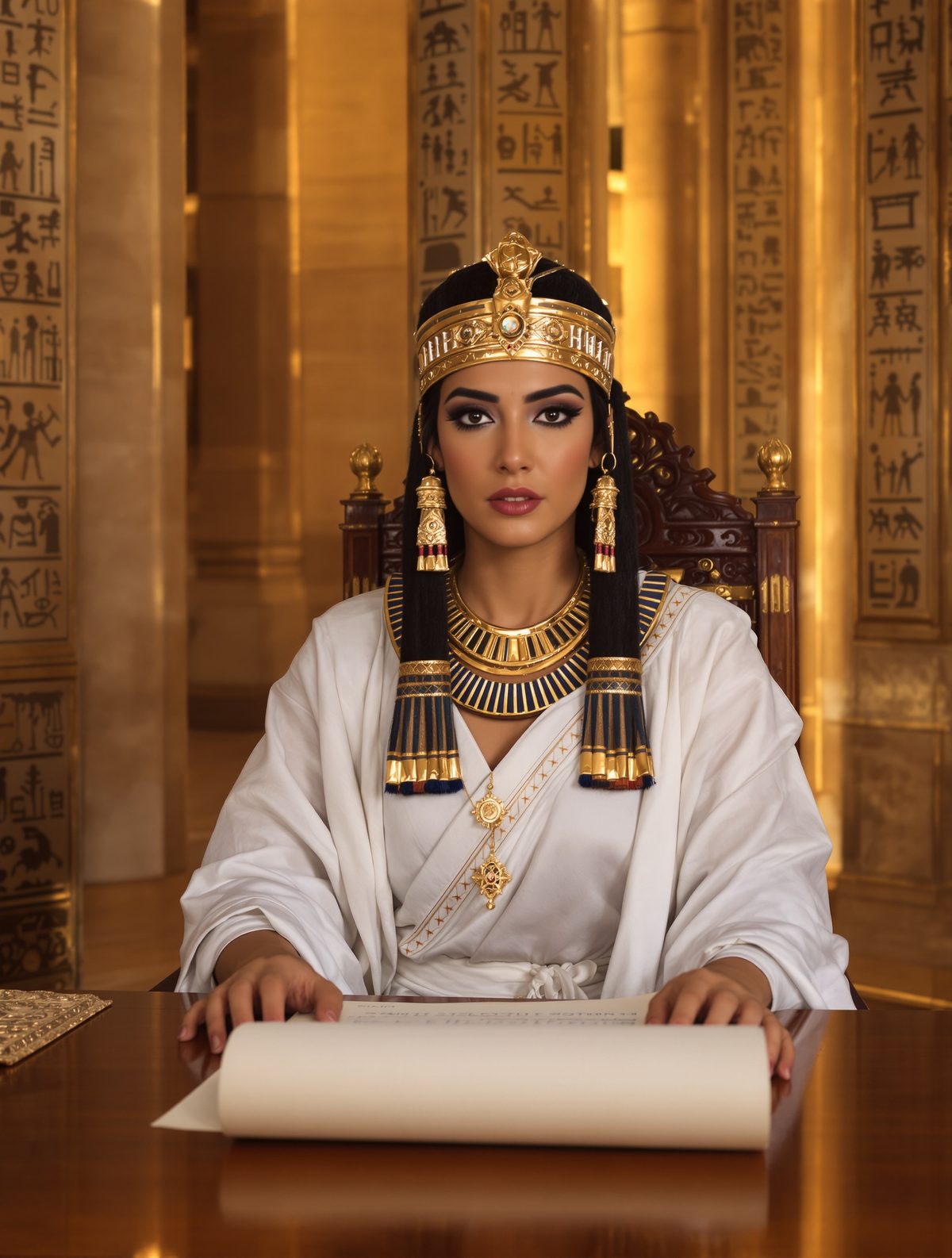
In the flickering candlelight of her palace chambers in Memphis, a teenage queen sat hunched over papyrus, her trembling hands forming words that could destroy two kingdoms. The year was 1323 BC, and Queen Ankhesenamun of Egypt was about to commit the ultimate act of treason. Her husband, the boy-king Tutankhamun, lay cold in his tomb, and the vultures were already circling. But instead of submitting to the fate that Egypt's power-hungry court had planned for her, this remarkable young woman chose to gamble everything on a letter to her nation's greatest enemy.
What she wrote next would send shockwaves through the ancient world and nearly trigger a war that could have rewritten history itself.
The Girl Who Became Queen of Two Worlds
Ankhesenamun wasn't born to be ordinary. Originally named Ankhesenpaaten, she was the third daughter of the most controversial pharaoh in Egyptian history—Akhenaten, the "heretic king" who had dared to abandon Egypt's ancient gods for the worship of a single deity, the sun disk Aten. Her childhood was spent in Amarna, Akhenaten's revolutionary capital city built from scratch in the desert, where traditional Egyptian art, religion, and culture were turned upside down.
But here's where the story gets truly extraordinary: when she married her half-brother Tutankhamun around 1332 BC, she wasn't just becoming queen of Egypt. She was helping to heal a kingdom torn apart by religious civil war. Tutankhamun, guided by powerful advisors, was systematically dismantling his father Akhenaten's monotheistic revolution and restoring the old gods. Ankhesenamun changed her name from Ankhesenpaaten ("Living through the Aten") to Ankhesenamun ("Living through Amun"), symbolically embracing the return to traditional Egyptian religion.
For nearly a decade, the royal couple ruled Egypt during one of its most delicate periods. Ancient paintings in Tutankhamun's tomb show them as devoted partners—she anoints him with oils, presents him with flowers, and accompanies him on hunts. These intimate scenes, rare in Egyptian royal art, suggest theirs may have been more than just a political marriage. They were two young people trying to hold together an empire while barely out of their teens.
Death in the Palace
Then, in 1323 BC, disaster struck. Tutankhamun died suddenly at just 19 years old, with no male heir to inherit the throne. Modern forensic analysis of his mummy reveals a suspicious pattern of injuries—a hole in the back of his skull and a broken rib cage that could indicate he was murdered. The prime suspect? Ay, the elderly grand vizier who had been the true power behind the teenage pharaoh's throne.
Ay was a survivor, a man who had served under four different pharaohs and navigated every political storm for decades. Ancient Egyptian records show he held the rare title "God's Father," possibly indicating he was Tutankhamun's grandfather or great-uncle. But family ties meant little when it came to power, and with Tutankhamun dead, Ay saw his chance to claim the ultimate prize—the crown of Egypt itself.
There was just one problem: to legitimize his rule, he needed to marry the widowed queen. Ankhesenamun, barely in her twenties, faced the horrifying prospect of becoming the wife of the man who had likely murdered her husband. In ancient Egypt, the queen's bloodline carried immense symbolic power, and marrying her would give Ay the divine legitimacy he desperately needed.
But Ankhesenamun had other plans.
The Letter That Could Have Changed History
Somewhere in the 70 days of Tutankhamun's mummification process, Queen Ankhesenamun made a decision that defied every convention of ancient diplomacy. She wrote a secret letter to Suppiluliuma I, king of the Hittites—Egypt's most feared enemy and greatest rival for control of the ancient Near East.
The Hittite archives, discovered in modern-day Turkey, preserve her exact words: "My husband died. A son I have not. But to you, they say, the sons are many. If you would give me one son of yours, he would become my husband. Never shall I pick out a servant of mine and make him my husband! I am afraid!"
Think about the audacity of this moment. The queen of Egypt was asking the king of her nation's greatest enemy to send a prince to marry her and potentially rule Egypt. It was like asking Hitler to provide a husband during World War II. The geopolitical implications were staggering.
Suppiluliuma was initially suspicious, thinking it might be a trap. He sent an envoy to verify the situation, who reported back: "Since my father had never experienced such a thing, the matter of the daughter troubled him greatly." The Hittite king ultimately decided to take the risk, sending his son Prince Zannanza to Egypt to marry the desperate queen.
When Desperation Meets Destiny
What happened next reads like a ancient thriller. Prince Zannanza never made it to Egypt alive. Historical records suggest he was murdered en route, almost certainly on Ay's orders. The elderly vizier had discovered the queen's treacherous correspondence and moved quickly to eliminate the threat to his ambitions.
With her Hittite prince dead and her secret exposed, Ankhesenamun's fate was sealed. Ay forced her into marriage, and archaeological evidence suggests the wedding took place shortly after Tutankhamun's burial. A ring bearing both their names, discovered by archaeologists, provides haunting proof of this unwanted union.
But Ankhesenamun's story didn't end there. Within just two years of Ay's coronation, she had vanished completely from the historical record. No tomb, no mention in court documents, no trace of the woman who had once been queen of Egypt. Most historians believe Ay had her quietly eliminated once her usefulness as a legitimizing bride had expired.
The murder of Prince Zannanza, however, had far-reaching consequences. It sparked a series of wars between Egypt and the Hittite Empire that would rage for decades, fundamentally reshaping the balance of power in the ancient world. Ankhesenamun's desperate letter had lit a fuse that would explode across the Near East.
The Queen Who Dared to Choose
Recent archaeological discoveries have shed new light on Ankhesenamun's story. In 2010, DNA analysis revealed that two female fetuses found in Tutankhamun's tomb were likely his and Ankhesenamun's children—daughters who died in infancy, leaving the royal couple childless and the succession uncertain. These tiny mummies add a heartbreaking dimension to the queen's desperate situation. She had already lost two babies; now she faced losing her freedom, her throne, and quite possibly her life.
Some Egyptologists have speculated that a mysterious female mummy known as the "Younger Lady," discovered in tomb KV35, might be Ankhesenamun. DNA analysis has proven this mummy is the daughter of Akhenaten and the mother of Tutankhamun's stillborn children—exactly matching what we know about the vanished queen. If true, the physical evidence suggests she met a violent end, with damage to her face that could indicate she was murdered.
What makes Ankhesenamun's story so compelling isn't just the political intrigue or the international consequences of her actions. It's the very human story of a young woman refusing to be powerless in a world that gave her no choices. In an age when royal women were treated as political pawns, she dared to try to control her own destiny, even if it meant betraying her kingdom.
Her letter to the Hittite king represents one of the earliest recorded examples of a woman attempting to use international diplomacy to escape domestic oppression. In our modern era of global connectivity and women's rights movements, Ankhesenamun's desperate gambit feels remarkably contemporary. She reminds us that the desire for agency, for the right to choose one's own path, transcends time, culture, and circumstance.
The teenage queen who tried to save herself by writing to her nation's enemy ultimately failed, but her courage in making that attempt echoes across 3,300 years. In a world that wanted to silence her, Ankhesenamun found a way to make her voice heard—even if we only discovered it millennia later, preserved in the archives of the very people she had hoped would save her.