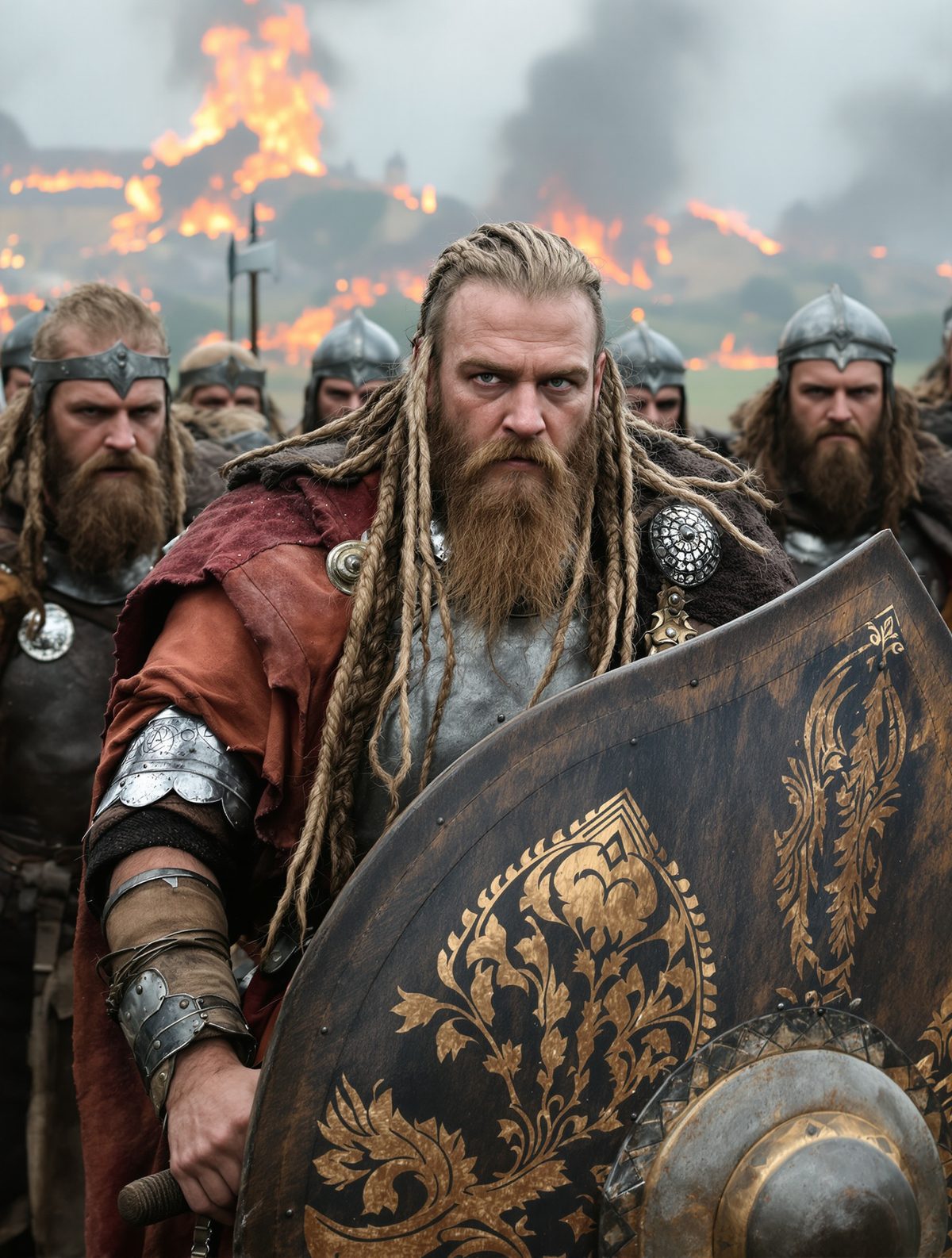
The year was 866 AD, and the walls of York trembled as thousands of Viking warriors surged through its gates. At the heart of this terrifying horde, four burly Norsemen carried a shield bearing their commander—a man who couldn't walk, yet had just orchestrated the conquest of northern England's greatest city. His piercing blue eyes surveyed the burning buildings and fleeing Anglo-Saxons as his warriors lifted him higher, roaring his name: "Ivar! Ivar the Boneless!" History has rarely seen such a paradox—a military genius whose broken body belied one of the most brilliant tactical minds of the Viking Age.
While Hollywood Vikings swing axes with brute force, the real Ivar the Boneless conquered through cunning, political manipulation, and an understanding of warfare that was centuries ahead of his time. This is the extraordinary story of how a disabled Viking prince became the most feared commander in medieval Europe, leading the largest invasion force in Viking history to carve up Anglo-Saxon England like a Christmas feast.
The Mystery of Broken Bones
Ivar Ragnarsson earned his chilling epithet not through cowardice or weakness, but from a condition that left his legs unable to support his weight. The exact nature of his disability remains one of history's most intriguing medical mysteries. Medieval chroniclers offer tantalizing clues: the Gesta Danorum describes him as "without bones in his legs," while the Tale of Ragnar's Sons tells us his enemies had to carry him on a shield or in a wagon.
Modern historians have proposed everything from osteogenesis imperfecta (brittle bone disease) to spina bifida, but the most compelling theory suggests Ivar suffered from a severe form of arthritis or bone disease that left his lower limbs essentially useless. What's remarkable isn't his condition—it's that in an age when physical prowess meant everything to a warrior culture, Ivar not only survived but thrived.
Born around 830 AD as the son of the legendary Ragnar Lothbrok (yes, the same Ragnar from the TV series), Ivar grew up in a world where weakness meant death. Viking society had little patience for the infirm, yet somehow this young prince transformed his greatest liability into his most fearsome asset. Unable to prove himself with sword and shield, Ivar developed something far more dangerous: a strategic mind that could see three moves ahead of his enemies.
Forging the Great Heathen Army
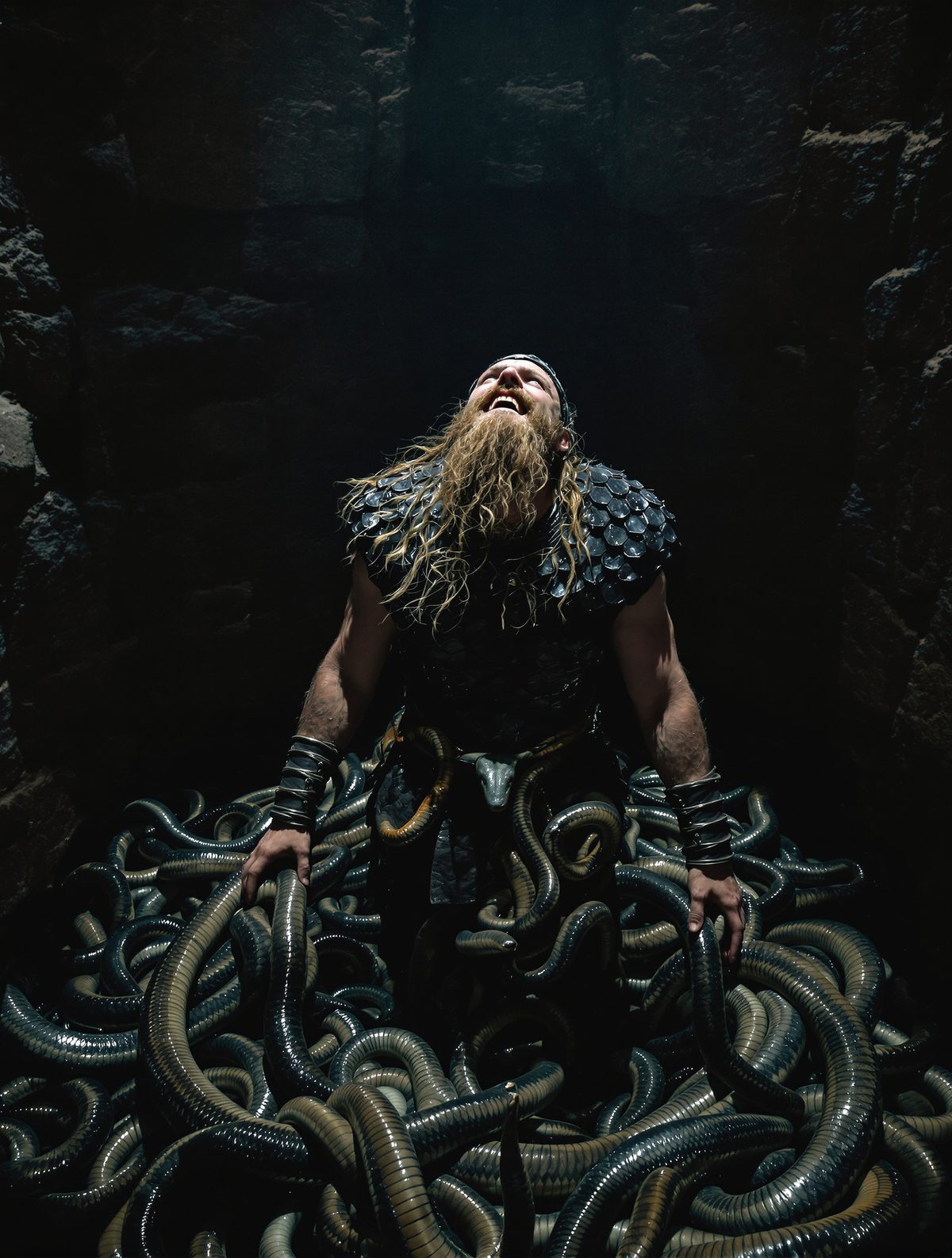
In 865 AD, Ivar accomplished something that had never been done before in Viking history—he united dozens of warring Norse factions under a single banner. The catalyst was revenge: King Ælla of Northumbria had allegedly executed Ragnar Lothbrok by throwing him into a pit of venomous snakes, and Ivar intended to make every English kingdom pay for this insult.
The force Ivar assembled was staggering in its scope. Medieval sources describe the Great Heathen Army as numbering in the thousands—some estimates suggest up to 3,000 warriors, making it larger than most standing armies of the time. But numbers alone don't explain Ivar's success. What made this invasion different was its organization and strategic coordination.
Previous Viking raids had been hit-and-run affairs: strike fast, grab treasure, sail home. Ivar envisioned something far more ambitious—permanent conquest. He recruited not just warriors, but craftsmen, settlers, and administrators. This wasn't a raid; it was a planned colonization effort that would reshape the genetic and cultural map of England forever.
The army landed in East Anglia in autumn 865, and Ivar immediately demonstrated why his disability had never hindered his leadership. Unable to charge into battle himself, he had developed an almost supernatural ability to read terrain, predict enemy movements, and coordinate complex multi-front campaigns. His warriors didn't just follow him—they revered him, believing that his unusual condition marked him as chosen by the gods.
The Chess Master of Medieval Warfare
What happened next reads like a medieval masterclass in military strategy. Rather than attacking the strongest Anglo-Saxon kingdom first, Ivar played a brilliant game of divide and conquer that exploited every political weakness in 9th-century England.
His first move was pure genius: he negotiated a temporary peace with East Anglia's King Edmund, extracting horses and supplies for his army while gathering intelligence on the other kingdoms. As his men rested and resupplied, Ivar's spies mapped out the political landscape of northern England, identifying which nobles could be bought, which alliances were fragile, and where the next target's weaknesses lay.
In November 866, Ivar struck at York, the capital of Northumbria. The timing was perfect—the kingdom was in the midst of a civil war between rival claimants Ælla and Osberht. While these two kings fought each other, Ivar's army simply walked into their greatest city. The Anglo-Saxon Chronicle records the Vikings' entry into York with shocking brevity: "Here the army went from East Anglia over the mouth of the Humber to York in Northumbria."
But Ivar's masterstroke was yet to come. When Ælla and Osberht finally united to retake York in March 867, they found the Vikings had turned the city into an impregnable fortress. The ensuing battle was a massacre—both Anglo-Saxon kings died, along with eight of their earls. Ivar had eliminated Northumbria's entire leadership structure in a single afternoon.
The Blood Eagle and the Art of Terror
With Northumbria secured, Ivar demonstrated that his strategic brilliance had a dark companion: psychological warfare that would make Machiavelli proud. The fate of King Ælla became a legend that spread terror throughout Anglo-Saxon England, ensuring that future enemies would think twice before opposing the Boneless.
According to Norse sagas, Ivar subjected Ælla to the infamous "blood eagle"—a ritualistic execution so gruesome that historians still debate whether it actually existed or was merely Viking propaganda. The process allegedly involved cutting the ribs from the spine and pulling the lungs out to form "wings" while the victim was still alive. Whether Ivar actually performed this ritual or simply spread rumors about it, the psychological effect was devastating.
Word of Ælla's fate reached every royal court in England. Here was a disabled Viking who couldn't walk, yet could orchestrate horrors that made hardened warriors wake up screaming. This wasn't just conquest—it was psychological domination on an unprecedented scale.
Ivar understood something that many military commanders miss: winning battles is only half the equation. The other half is ensuring your enemies are too terrified to fight effectively when they face you. By 868 AD, Anglo-Saxon armies were already demoralized before they even saw the Great Heathen Army approaching.
The Puppet Master of Mercia and Beyond
Having conquered the north, Ivar turned his attention to Mercia, one of the most powerful Anglo-Saxon kingdoms. But rather than launch another military campaign, he chose a different approach that revealed the sophisticated political mind behind the warrior's reputation.
In 868, Ivar negotiated with King Burgred of Mercia, essentially turning the entire kingdom into a Viking client state without firing a single arrow. Burgred agreed to pay tribute and provide winter quarters for the Great Heathen Army in exchange for being allowed to keep his throne. It was a masterful piece of diplomacy that gave Ivar control over central England while preserving his army's strength for future campaigns.
Meanwhile, Ivar was already planning his next move against Wessex, the last major Anglo-Saxon kingdom still outside his influence. In 870, his forces invaded Wessex and engaged in a series of battles with a young prince named Alfred—later known as Alfred the Great. This campaign would prove to be Ivar's most challenging, as Alfred possessed a strategic mind that could match the Viking commander's own.
The fact that Ivar fought Alfred to a standstill speaks volumes about both men's abilities. While Alfred ultimately prevented the complete Viking conquest of Wessex, Ivar had still managed to control or influence nearly two-thirds of England—an achievement that wouldn't be matched until the Norman Conquest two centuries later.
Legacy of the Boneless
Ivar the Boneless disappeared from historical records around 873 AD, probably dying in England or Ireland, but his impact on British history was nothing short of revolutionary. The kingdoms he conquered became the foundation of the Danelaw, a Viking-controlled region that would influence English law, language, and culture for centuries.
Modern DNA studies reveal that Ivar's invasion had lasting genetic consequences—millions of people in northern England and Ireland can trace their ancestry back to Norse settlers who arrived with the Great Heathen Army. Place names throughout Yorkshire, Lincolnshire, and the East Midlands still bear Viking origins, testament to the permanence of Ivar's conquests.
But perhaps Ivar's most significant legacy lies in what he represented: proof that physical limitations need not define human potential. In an age that worshipped physical strength above all else, a man who couldn't walk became the most feared military commander of his generation. His story challenges our assumptions about disability, leadership, and the nature of power itself.
Today, as we grapple with questions of inclusion and accessibility, Ivar the Boneless offers a striking historical parallel. His warriors didn't carry him into battle out of pity—they did it because his strategic genius made them nearly invincible. He earned respect not despite his disability, but through the sheer force of his intellectual capabilities and leadership skills.
In the end, Ivar the Boneless achieved something that countless "whole" men could not: he changed the course of history itself. The next time you hear someone suggest that physical limitations preclude greatness, remember the Viking who conquered half of England from the back of a shield—and remind them that the strongest weapon has always been the human mind.