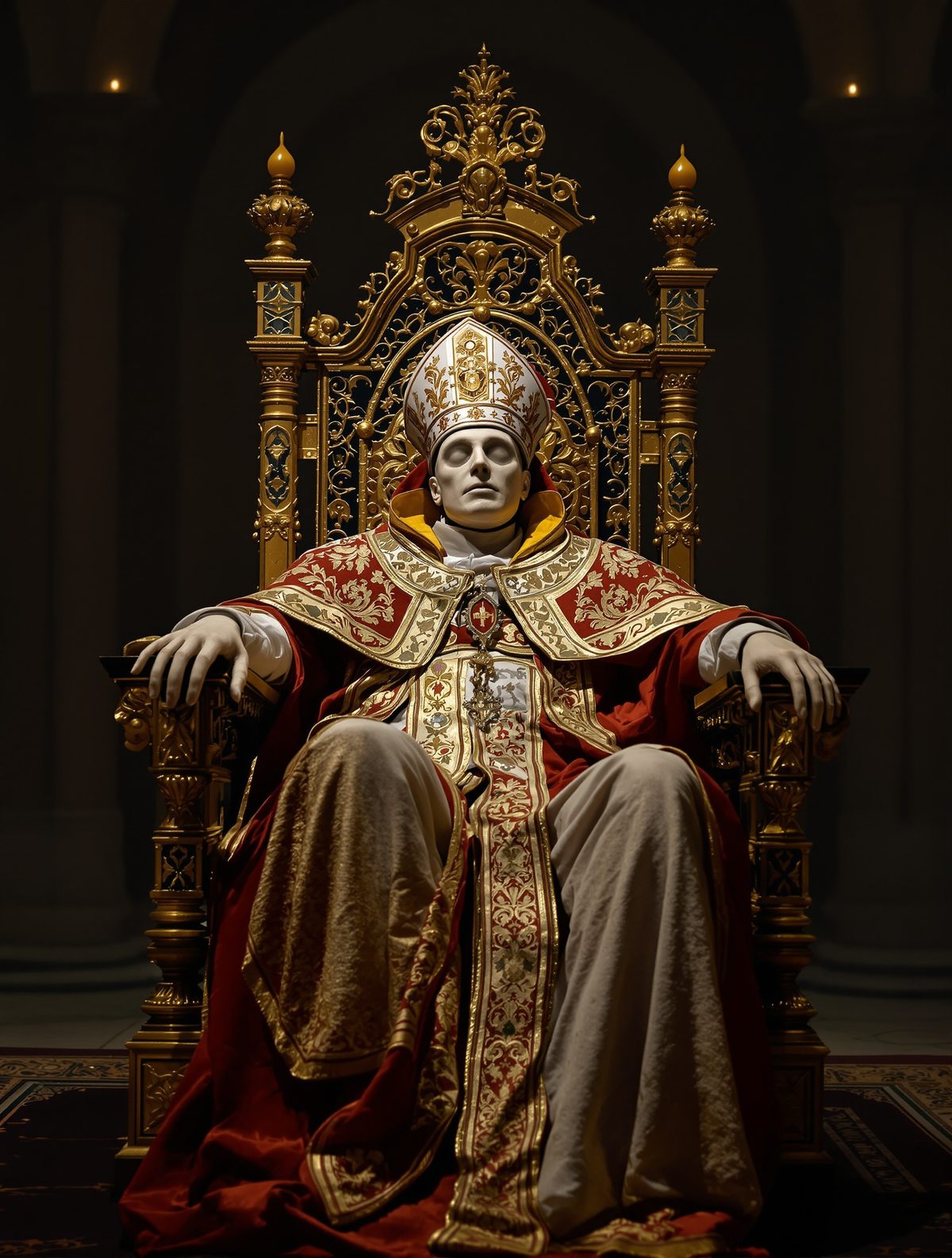
Picture, if you will, the most sacred halls of the Vatican in January 897 AD. Cardinals and clergy file into the papal court, their faces grim with anticipation. But this is no ordinary ecclesiastical gathering. At the center of the room sits a grotesque figure—a decomposed corpse propped up on a throne, draped in the golden vestments of the papacy. The dead pope's jaw hangs open in a silent scream, his flesh blackened and rotting after months in the tomb. This is Pope Formosus, and he's about to stand trial for his life... or rather, his afterlife.
What you're witnessing is the Cadaver Synod, the most bizarre and macabre trial in the history of the Catholic Church. Pope Stephen VI, driven by political fury and personal vendetta, had ordered his predecessor's corpse exhumed, dressed, and put on trial for crimes against the Church. It was a spectacle so shocking that it would haunt the papacy for centuries to come.
The Pope Who Wouldn't Stay Dead
To understand this medieval nightmare, we must first meet Pope Formosus, a man whose very name means "handsome" in Latin—though beauty would be the last thing associated with him by January 897. Formosus had been a controversial figure long before his death in April 896. Born around 816 AD, he rose through Church ranks as a brilliant diplomat and theologian, but his political maneuvering made him powerful enemies.
During his papacy from 891 to 896, Formosus made a decision that would literally come back to haunt his corpse: he crowned Arnulf of Carinthia as Holy Roman Emperor, directly challenging the power of the Spoletan dynasty that controlled much of central Italy. This wasn't just a religious ceremony—it was a declaration of war against the political establishment that had dominated Italian politics for decades.
Lambert of Spoleto and his mother, Agiltrude, never forgave this betrayal. When Formosus died—possibly of natural causes, though some whispered of poison—they saw an opportunity for the ultimate revenge. They needed a puppet pope to carry out their vendetta, and they found their man in Stephen VI.
The Making of a Mad Pope
Stephen VI was not mad when he became pope in May 896, just ambitious and deeply indebted to the Spoletan faction. The powerful Agiltrude had maneuvered his election, and Stephen understood the price of her support: complete repudiation of everything Formosus had done. But what started as political calculation soon spiraled into something far darker.
Medieval chroniclers describe Stephen as becoming increasingly erratic in the months following his election. He began publicly denounce Formosus's entire papacy as illegitimate, declaring all his ordinations void and his papal acts invalid. Hundreds of priests and bishops found themselves suddenly stripped of their positions. But for Stephen and his Spoletan masters, this wasn't enough. They wanted complete and total humiliation of their enemy—even in death.
The idea of putting a corpse on trial wasn't entirely without precedent in the medieval world. Ancient Roman law had provisions for posthumous trials, and Byzantine emperors had occasionally ordered the bodies of enemies exhumed and desecrated. But never before had a Pope of Rome ordered such a spectacle, and certainly not in the sacred halls of the Vatican itself.
The Trial of the Dead
On a cold January morning in 897, the unthinkable began. Pope Stephen VI ordered the tomb of Formosus broken open in the cemetery of St. Peter's Basilica. The corpse, dead for nearly nine months, was hauled from its resting place by horrified gravediggers. What they found was a grotesque mockery of the man who had once led Christendom—flesh blackened with decay, features collapsed, the sweet stench of death clinging to rotted papal vestments.
But Stephen wasn't finished with his predecessor. The corpse was dressed in full papal regalia—the sacred vestments that symbolized Christ's authority on Earth. A papal mitre was placed on the decomposed skull, and the body was propped up on a throne in the papal court. A deacon was appointed to speak for the dead pope, though what words could possibly defend a man who could no longer draw breath?
The charges against Formosus were serious by medieval standards: perjury, coveting the papacy while serving as Bishop of Porto, and performing papal functions as a layman. But everyone in that courtroom knew the real crime—Formosus had crowned the wrong emperor and challenged Spoletan power. The trial was a farce, the verdict predetermined.
For hours, Pope Stephen VI ranted at the silent corpse, his voice echoing through the marble halls as he hurled accusations at the decomposing figure. Witnesses described the scene as horrifying—a mad pope screaming at a rotting body while the highest officials of the Church looked on in stunned silence.
Guilty as Charged... and Dead
The verdict was never in doubt. Pope Formosus was found guilty on all charges, his papacy declared null and void. But Stephen's revenge required more than just legal condemnation—it demanded physical humiliation. The three fingers of the right hand that Formosus had used to give papal blessings were severed from the corpse. The papal vestments were stripped away, and the body was dragged through the streets of Rome before being thrown into the Tiber River like common refuse.
The people of Rome, initially cowed by Stephen's authority, watched in growing horror. Many had loved Pope Formosus, remembering him as a learned and pious man who had tried to protect Rome from foreign invaders. The sight of their former pope's corpse being desecrated pushed the Roman population toward revolt.
But the story takes an even stranger turn. A hermit monk, fishing in the Tiber River, claimed to have found Formosus's body floating downstream. Word spread that the dead pope's corpse was performing miracles—healing the sick and appearing in visions to the faithful. Whether through genuine piety or political calculation, the monk brought the body back to Rome, where it was secretly reburied in St. Peter's Basilica.
Divine Justice and Earthly Consequences
Medieval chroniclers, ever eager to find God's hand in human affairs, claimed that divine justice quickly followed Stephen's sacrilege. In August 897, just months after the Cadaver Synod, an earthquake struck Rome. The Lateran Palace—the papal residence—suffered severe damage, with its walls cracking and portions collapsing. The Roman people, already horrified by the trial, saw this as a clear sign of divine displeasure.
Popular revolt followed natural disaster. The Roman mob, crying out for justice for Pope Formosus, stormed the papal palace. Stephen VI was captured, stripped of his papal vestments, and thrown into prison. Within days, he was found dead in his cell—strangled, according to most accounts, though whether by his own hand or those of his captors remains a mystery.
The aftermath of the Cadaver Synod plunged the papacy into chaos. Pope Romanus, Stephen's immediate successor, died under suspicious circumstances after just four months in office. His successor, Pope Theodore II, lasted only twenty days but managed to rehabilitate Formosus's memory and restore his papal acts. The next pope, John IX, formally condemned the Cadaver Synod and forbade any future trials of the dead.
When the Dead Won't Stay Buried
The Cadaver Synod represents more than just a bizarre footnote in Church history—it reveals the deadly intersection of politics, power, and religious authority that defined medieval Europe. In an age when kings and emperors fought over every scrap of territory, the papal crown represented the ultimate prize: divine authority over the souls of all Christendom.
Yet perhaps the most striking aspect of this macabre tale is how it demonstrates the limits of power. Pope Stephen VI commanded absolute authority over the Catholic Church, could crown emperors and excommunicate kings, but he couldn't kill his enemy's memory or silence the voice of public outrage. In trying to destroy Formosus completely, Stephen ensured that his predecessor would be remembered far more vividly than if he had simply let the dead pope rest in peace.
Today, as we watch modern political leaders attempt to destroy their predecessors' legacies and rewrite historical narratives, the Cadaver Synod serves as a stark reminder that some victories are too complete, some revenge too absolute. Sometimes, when you put the dead on trial, you end up condemning yourself to history's judgment instead.