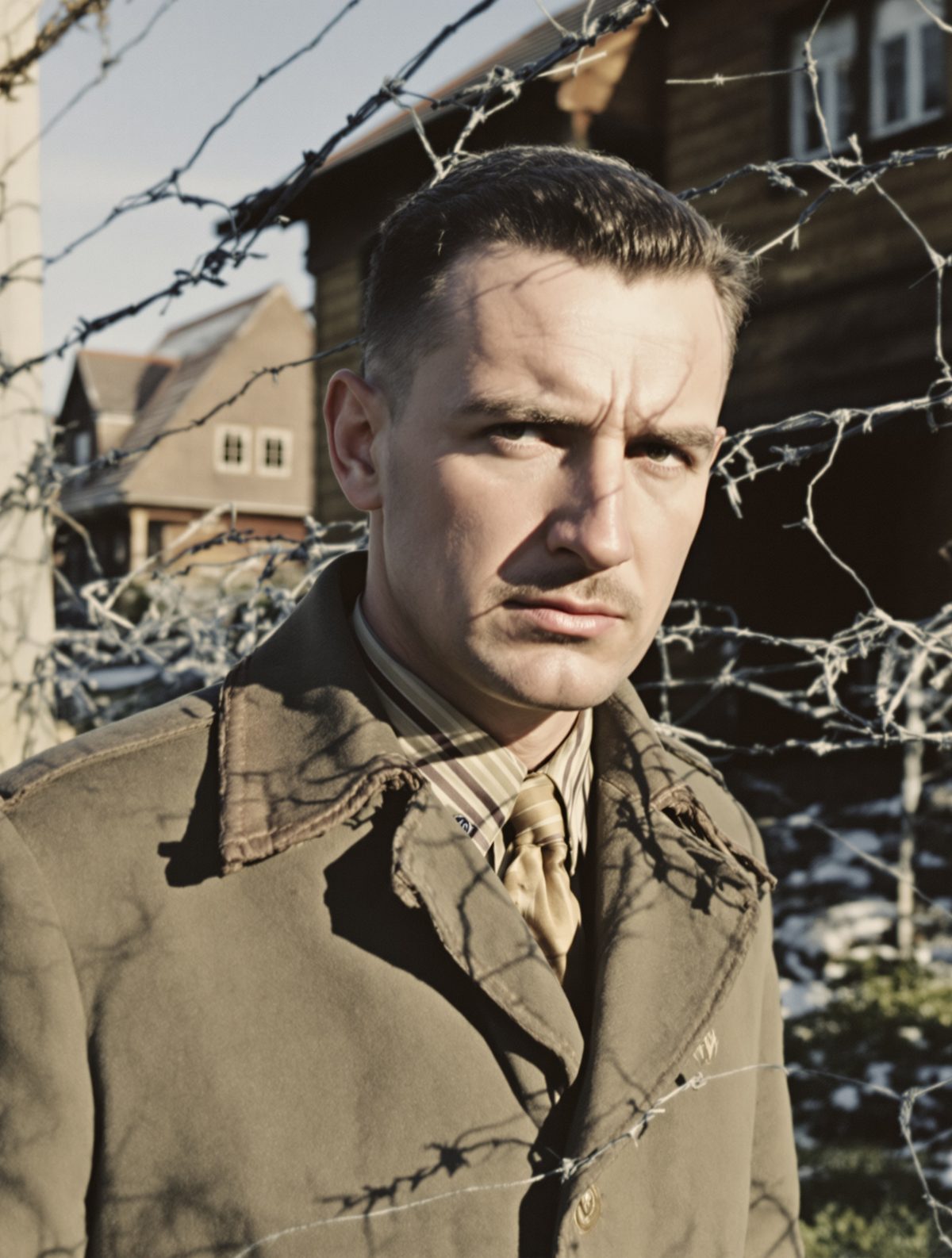
On a crisp September morning in 1940, a Polish cavalry officer named Witold Pilecki did something that defied every human instinct for survival. As Nazi soldiers rounded up civilians on the streets of Warsaw, most people ran. Pilecki walked straight toward them. He carried false identity papers and positioned himself deliberately in their path, waiting to be arrested. His destination? Auschwitz concentration camp. His mission? To organize resistance from within the most notorious prison in human history.
What happened next would become one of the most extraordinary acts of courage in World War II—a story so incredible that it sounds like fiction, yet every detail is documented in Pilecki's own reports smuggled from inside the death camp.
The Volunteer
Witold Pilecki wasn't your typical resistance fighter. Born in 1901 to a noble family in Russian-occupied Poland, he had already proven himself as a cavalry officer in the Polish-Soviet War and later as a reserve officer. When Germany invaded Poland in September 1939, followed by the Soviet Union from the east, Pilecki helped form the Secret Polish Army, one of the first resistance organizations in occupied Europe.
But by 1940, disturbing rumors were filtering out of southern Poland about a new kind of Nazi camp near the town of Oświęcim—known to Germans as Auschwitz. The Polish underground desperately needed intelligence about what was happening inside. They needed someone to organize resistance from within. And they needed someone willing to walk through hell's gates voluntarily.
Pilecki stepped forward without hesitation.
On September 19, 1940, using the false identity "Tomasz Serafiński," Pilecki deliberately placed himself in a Warsaw street roundup. The plan worked perfectly—too perfectly. As Nazi trucks hauled away their human cargo, Pilecki found himself crammed into a cattle car with nearly 2,000 other prisoners, bound for a place that would redefine the meaning of human evil.
Prisoner 4859
The train journey to Auschwitz took two days. When the doors finally opened, Pilecki got his first glimpse of what awaited him: snarling German shepherds, screaming guards with whips, and a gate bearing the cruelly ironic words "Arbeit macht frei"—Work makes you free.
Pilecki was assigned prisoner number 4859, tattooed into his forearm like livestock. What the guards didn't know was that they had just admitted a trained intelligence officer with a photographic memory and an iron will. What Pilecki didn't fully grasp yet was the sheer scale of the horror he had entered.
The statistics are numbing: prisoners received 700 calories per day while performing backbreaking labor for 11 hours. The death rate in those early months was staggering—of the 728 Polish political prisoners who arrived with Pilecki, only 92 survived the war. Men died from exhaustion, disease, random executions, and medical experiments. Bodies were everywhere.
But instead of breaking under these conditions, Pilecki began to build something unprecedented: a secret military organization inside Auschwitz itself.
Building an Underground Empire
Creating a resistance network inside Auschwitz required a special kind of genius. Pilecki had to identify trustworthy prisoners while avoiding informants who might trade information for an extra piece of bread. He had to establish communication methods under constant surveillance. And he had to do it all while appearing to be just another broken prisoner.
Working primarily in the camp's construction details, Pilecki slowly recruited men from different backgrounds: Polish officers, intellectuals, and skilled workers. His network, which he called the Union of Military Organization (ZOW), eventually grew to include nearly 1,000 members across the camp's sub-sections.
The ingenuity was remarkable. Messages were hidden in hollow wooden clogs, sewn into clothing, or passed through a complex chain of prisoners working different details. Pilecki's men secured extra food and medicine for sick prisoners, sabotaged German construction projects, and gathered intelligence on guard routines and camp operations.
Perhaps most incredibly, they began planning for an armed uprising. Pilecki hoped that if the Polish Home Army could attack Auschwitz from outside while his organization struck from within, they might liberate the camp. Weapons were slowly accumulated—stolen knives, smuggled guns, even explosives from work details. But the external attack Pilecki desperately awaited would never come.
Bearing Witness to Genocide
As months turned to years, Pilecki witnessed Auschwitz's transformation from a brutal prison camp into the epicenter of the Holocaust. In 1942, he watched in horror as trains began arriving packed with Jewish families—men, women, and children who disappeared into what prisoners called "the bathhouses" and were never seen again.
The scale was incomprehensible. On some days, up to 10,000 people were murdered in the gas chambers. Pilecki realized he wasn't just documenting a prison camp—he was witnessing industrialized genocide. His reports, smuggled out through an elaborate network of civilian contacts, became some of the first detailed accounts of the Holocaust to reach the outside world.
These reports were extraordinary documents. Written in precise military language, they detailed everything from the camp's layout and guard schedules to the horrific daily reality of mass murder. One report described how "the loading of people into trucks that went in the direction of the little red house was something so terrible that words cannot describe it."
But perhaps the most tragic aspect of Pilecki's intelligence was how it was received. His reports reached the Polish government-in-exile in London and, through them, the Allies. The response was devastating silence. Some officials thought the accounts were exaggerated. Others believed them but felt powerless to act. The bombers that could have destroyed the railway lines to Auschwitz continued to fly overhead to other targets.
The Great Escape
By early 1943, Pilecki faced a terrible realization. His hoped-for uprising wasn't coming, and the camp's expanding role as a death factory meant that staying inside might accomplish nothing more than adding his name to the victim count. After nearly three years of gathering intelligence and organizing resistance, he made another audacious decision: he would escape.
On the night of April 26-27, 1943, Pilecki and two other prisoners executed a plan months in the making. Working in a camp bakery outside the main compound, they overpowered a guard, cut through the telephone wires, and disappeared into the Polish countryside. The manhunt that followed involved thousands of German soldiers and police, but Pilecki had simply vanished.
His escape was more than a personal liberation—it was a intelligence coup. For the first time, someone with intimate knowledge of Auschwitz's operations had made it out alive and could provide firsthand testimony about the genocide taking place there.
The Price of Truth
Pilecki's story should have ended in triumph, but history had one more cruel twist. After the war, as communist Poland fell under Soviet control, Pilecki's anti-communist activities made him a target of the new regime. In 1947, he was arrested by Polish security forces, tortured, and subjected to a show trial. On May 25, 1948, Witold Pilecki was executed by firing squad in Warsaw—killed not by the Nazis he had fought, but by the Polish state he had served.
For decades, communist authorities suppressed his story. His family was persecuted, his name erased from official histories. It wasn't until 1990, after the fall of communism, that Poland began to rediscover the man who had volunteered for hell itself in the service of human dignity.
Today, as we grapple with our own questions about courage in the face of injustice, Pilecki's example burns like a beacon. In an age of social media activism and keyboard warriors, here was someone who didn't just bear witness to evil—he walked deliberately into its heart to fight it from within. His story reminds us that the most profound acts of resistance often require not just moral courage, but the willingness to sacrifice everything for the truth. In a world still plagued by genocide, authoritarianism, and the silence of bystanders, perhaps the most important question Witold Pilecki's life poses is this: what would we volunteer for?