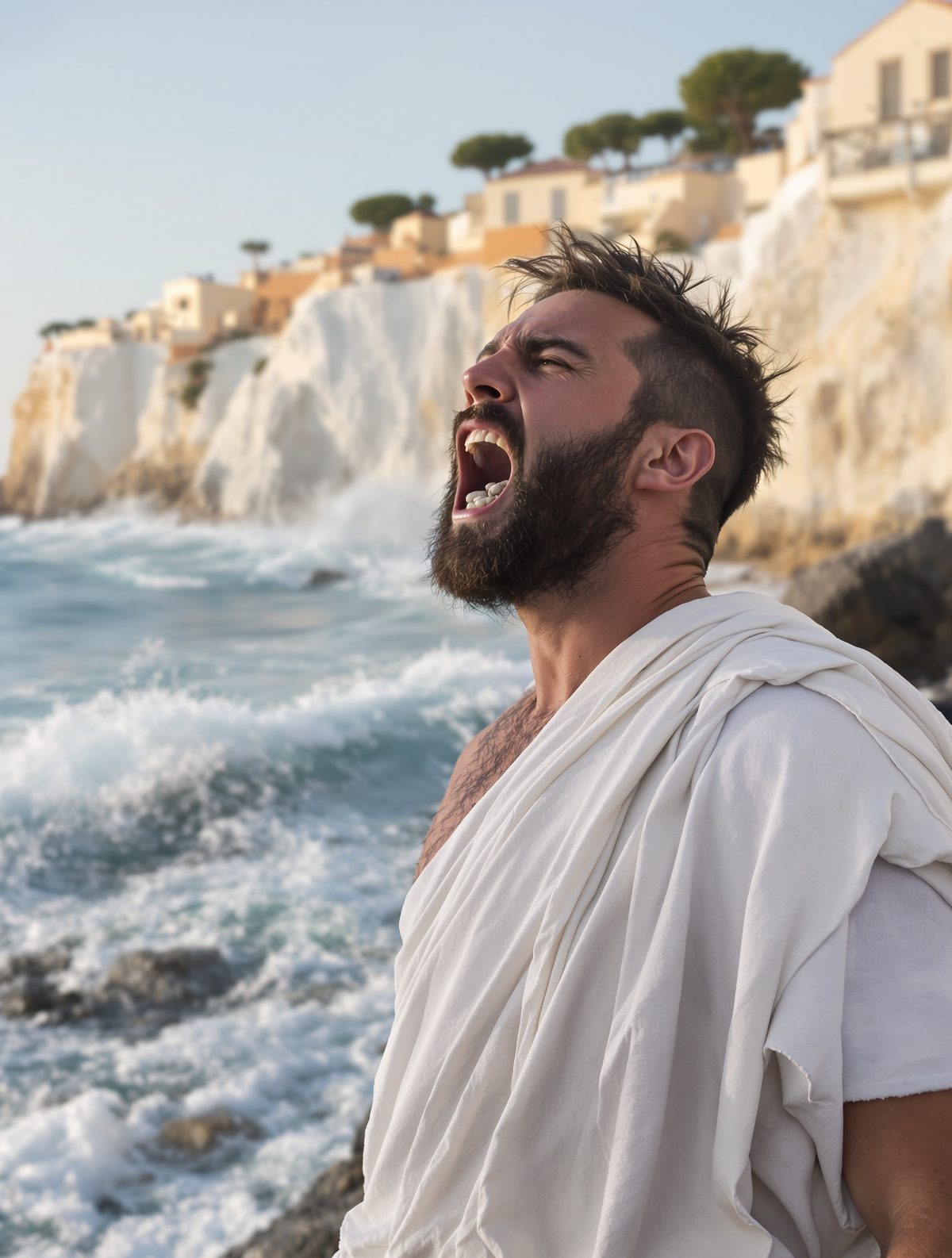
Picture this: a scrawny, stuttering boy stands alone on the rocky shores of the Aegean Sea, his mouth stuffed with smooth pebbles, screaming unintelligible words at the crashing waves. The Mediterranean wind whips his toga as he struggles to form even the simplest sounds. Passersby shake their heads in pity—or perhaps amusement—at this strange spectacle. They have no idea they're witnessing one of history's most extraordinary transformations in the making.
That boy was Demosthenes, and within two decades, his voice would become the most feared weapon in ancient Athens. The same mouth that once couldn't pronounce his own name would deliver speeches so powerful they could rouse an entire city-state to war, topple political careers with a single phrase, and make the mighty Philip II of Macedon curse his name across the northern mountains of Greece.
The Orphan's Burden: A Childhood Stolen
Demosthenes was born around 384 BC into a wealthy Athenian family, but fate dealt him a cruel hand early. When he was just seven years old, his father—a successful sword-maker and military contractor—died suddenly, leaving behind a substantial fortune. According to Athenian law, three guardians were appointed to manage the estate until young Demosthenes came of age. It should have been a comfortable arrangement, but these men had other plans.
The guardians systematically plundered the family wealth, treating the inheritance as their personal treasury. By the time Demosthenes reached eighteen, nearly everything was gone. The workshops were shuttered, the house was crumbling, and the family's social standing had evaporated. But perhaps most devastating of all was the physical and emotional toll this betrayal took on the boy.
Already cursed with a severe stutter, weak lungs, and what ancient sources describe as "an inarticulate and stammering pronunciation," Demosthenes found himself powerless in every sense of the word. In a society where eloquence was political power, where the ability to speak persuasively in the agora could make or break a man's fortune, he was essentially voiceless. His guardians had stolen not just his money, but seemingly his entire future.
The Fire of Revenge Ignites
At eighteen, Demosthenes made a decision that would change the course of his life—and ultimately, the fate of Greece itself. He would take his crooked guardians to court and recover his inheritance. There was just one problem: he would have to argue the case himself. In ancient Athens, there were no lawyers as we know them today. Citizens had to present their own cases before juries that could number in the hundreds.
For most people, this would have been daunting. For a young man who could barely string two words together without stumbling, it seemed impossible. But desperation breeds determination, and Demosthenes possessed something his guardians had never anticipated: an iron will that would become legendary.
He sought out Isaeus, one of Athens' most renowned teachers of rhetoric, and begged to be trained in the art of public speaking. Isaeus initially refused—what was the point of teaching someone who couldn't even pronounce basic words clearly? But Demosthenes persisted with such intensity that the master eventually relented, perhaps seeing something extraordinary burning behind the young man's desperate eyes.
Pebbles, Waves, and a Sword's Edge
What happened next has become one of history's most inspiring tales of self-transformation, though it reads more like myth than reality. Demosthenes didn't just practice speaking—he declared war on his own limitations with methods that bordered on the extreme.
The most famous of his techniques involved filling his mouth with small, smooth pebbles and attempting to speak clearly despite this obstacle. The logic was simple but brutal: if he could articulate words with stones rolling around his tongue, speaking without them would feel effortless by comparison. Day after day, he would stand by the seashore, pebbles clicking against his teeth, shouting speeches at the Mediterranean waves.
But why the ocean? Demosthenes had noticed that his weak voice was one of his greatest handicaps. The roaring surf provided the ultimate audio challenge—to be heard above the crashing waves, he had to project his voice with tremendous power and clarity. Ancient sources tell us he would recite entire passages from Homer and other classics, competing with the endless thunder of water against rock until his voice could cut through any din.
Perhaps most remarkably, he addressed his tendency to shrug his shoulders while speaking—a nervous tic that undermined his authority—by practicing with a sword suspended from the ceiling, positioned so that any upward movement of his shoulder would result in a painful prick. For months, he trained under this literal sword of Damocles, conditioning his body to remain perfectly still while his voice did all the work.
The Student Becomes the Master
When Demosthenes finally faced his guardians in court around 364 BC, the transformation was startling. The stuttering boy was gone, replaced by a young man whose words flowed like honey—when he chose to be persuasive—or struck like lightning when he meant to destroy. He not only won his case but did so with such eloquence that spectators reportedly wept at his description of the injustices he had suffered.
Unfortunately, victory in court didn't immediately restore his fortune. His guardians had spent most of the money, and what remained was tied up in legal complexities. But Demosthenes had gained something far more valuable than gold: he had discovered his true calling. The boy who once couldn't speak had become a master of words, and in ancient Athens, words were the ultimate currency.
He began taking cases as a speech-writer, crafting orations for other citizens to deliver in court. This was common practice—while people had to speak for themselves, they could hire professionals to write their speeches. Demosthenes proved to have an almost supernatural ability to understand human psychology and craft arguments that struck directly at jurors' hearts and minds.
The Voice That Challenged an Empire
By his thirties, Demosthenes had evolved from a private speech-writer into Athens' most formidable political orator. But his greatest challenge was yet to come, in the form of a one-eyed king from the northern kingdom of Macedon: Philip II.
Philip was methodically conquering Greek city-states, using a combination of military might and diplomatic cunning to expand his empire southward. Many Athenians were inclined to accommodate this rising power, preferring comfortable submission to costly resistance. But Demosthenes saw Philip's true intentions with crystal clarity and was horrified by his countrymen's complacency.
Between 351 and 341 BC, Demosthenes delivered a series of speeches that became known as the Philippics—political orations so powerful they've given us the modern term for any bitter verbal attack. In these speeches, he painted Philip not as a potential ally but as an existential threat to Athenian democracy and Greek freedom itself.
"Philip is not only no Greek, nor related to the Greeks, but not even a barbarian from any place that can be named with honor, but a pestilent knave from Macedonia, from where it was never yet possible to buy a decent slave," he thundered in one particularly memorable passage.
The impact was electric. Demosthenes' voice—the same voice that once couldn't pronounce simple words—now had the power to rouse an entire city to action. His speeches were so effective that Philip II himself reportedly said he feared Demosthenes' orations more than the Athenian navy.
Legacy of the Stuttering Orator
Demosthenes' story didn't end with simple triumph—Philip II was eventually assassinated, but his son Alexander the Great would go on to conquer most of the known world, including Athens. When Alexander died and his empire crumbled, Demosthenes briefly saw an opportunity for Greek independence, but he backed the wrong side in the resulting power struggle. In 322 BC, facing capture by Macedonian forces, he took poison and died on the island of Calauria.
But his true legacy lies not in political success or failure, but in the extraordinary transformation he achieved through sheer determination. The boy who couldn't speak became the man whose words echoed across centuries. Roman orators studied his techniques, Renaissance scholars translated his works, and modern speechwriters still analyze his methods.
In our age of social anxiety and communication challenges, Demosthenes' story carries a particularly powerful message. He reminds us that our greatest limitations can become the foundation of our greatest strengths—but only if we're willing to fill our mouths with stones, face the roaring waves, and practice under the sword's edge until we master what once mastered us. The stuttering boy from Athens didn't just overcome his speech impediment; he transformed it into a voice that changed history.