
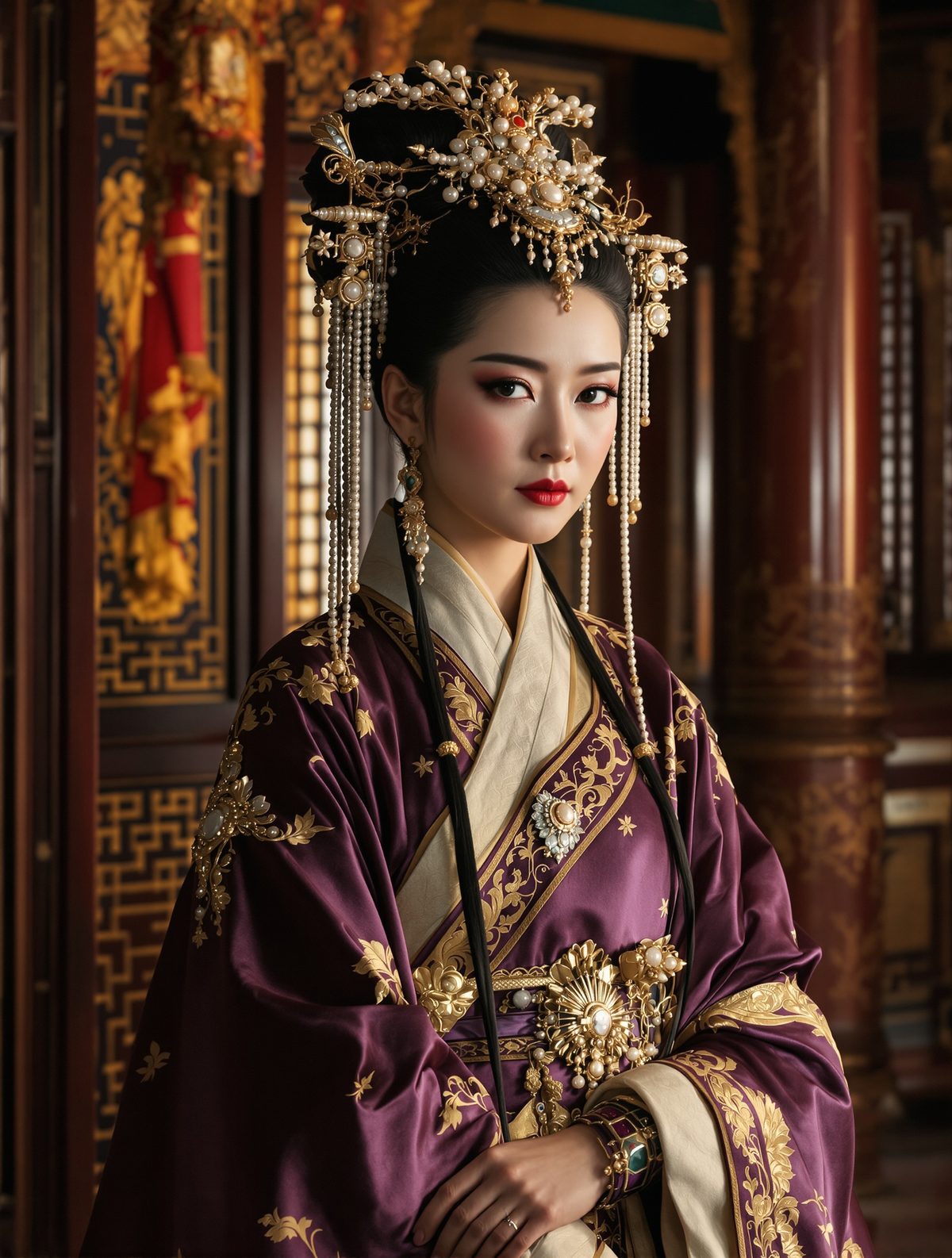
In the gilded corridors of the Daming Palace on a summer morning in 655 AD, a child's cry was suddenly, terrifyingly silenced. When Wu Zetian discovered her infant daughter's lifeless body in the silk-draped nursery, her screams of anguish echoed through the imperial quarters. But as Emperor Gaozong rushed to console his beloved concubine, Wu's tears masked a calculation so cold, so ruthless, that it would reshape Chinese history forever. The baby had not died of natural causes—and the woman weeping over the tiny corpse was not a grieving mother, but her killer.
What happened next would topple an empress, elevate a concubine, and eventually place the only woman in Chinese history on the Dragon Throne. But the price of ultimate power was the life of Wu Zetian's own child, sacrificed in a game of palace intrigue that makes Game of Thrones look like a children's fairy tale.
The Concubine Who Refused to Disappear
Wu Zetian's path to power began not in the glittering halls of the Tang Dynasty, but in the harsh realities of imperial succession. Born around 624 AD to a wealthy merchant family, she first entered the Forbidden City at fourteen as a low-ranking concubine to Emperor Taizong. When he died in 649 AD, tradition demanded that all his concubines be banished to Buddhist convents—a living death that awaited thousands of women whose only crime was outliving their imperial master.
But Wu Zetian was not like other concubines. While her sister wives resigned themselves to shaved heads and prayer beads, Wu had already begun weaving a web that would ensnare the next emperor. During Taizong's final illness, she had caught the eye of his son, the future Emperor Gaozong. In direct violation of Confucian taboos that made such relationships tantamount to incest, the prince smuggled Wu back into the palace after his father's death.
By 652 AD, Wu had given birth to her first son, Prince Li Hong. She was no longer just a concubine—she was the mother of a potential heir. But standing between her and true influence was Empress Wang, Gaozong's childless wife who had initially welcomed Wu's return, believing the beautiful concubine would distract the emperor from his other favorite, Consort Xiao.
It was a catastrophic miscalculation. The empress had invited a viper into her nest.
The Perfect Trap
The morning of the infanticide began like any other in the women's quarters of the palace. Empress Wang, fulfilling her ceremonial duties, paid a visit to Wu Zetian's newborn daughter—a routine gesture of imperial benevolence that would seal her doom. Historical records suggest the baby was healthy when the empress departed, cooing softly in her lacquered crib while servants bustled about their morning tasks.
What happened in the following hour would never be proven in any court, but the circumstantial evidence is damning. Wu had deliberately dismissed her usual retinue of servants and wet nurses, leaving herself alone with the infant. When Emperor Gaozong arrived for his own visit—timing that was surely no coincidence—Wu's discovery of the tiny corpse appeared spontaneous, devastating, and completely believable.
The theatrical performance that followed would have impressed any opera master. Wu's grief seemed utterly genuine as she collapsed over her daughter's body, her silk robes staining with tears. But when she lifted her eyes to meet the emperor's horrified gaze, her words carried the precision of a master strategist: "The empress was here," she sobbed. "She was the only one who visited today."
The accusation hung in the perfumed air like incense smoke. Gaozong, already deeply infatuated with Wu and increasingly distant from his barren wife, felt his shock crystallize into rage. In that moment, staring at the dead child and Wu's tear-streaked face, he made the decision that would alter the course of Chinese history.
The Empress Falls
Emperor Gaozong's response was swift and merciless. Despite the complete lack of evidence—and the empress's frantic protests of innocence—he ordered an immediate investigation that was really nothing more than a formality. The verdict was predetermined: Empress Wang was guilty of infanticide, the most heinous crime imaginable in a culture that revered motherhood and protected children above all else.
But Wu Zetian's ambitions extended beyond mere revenge. She convinced the emperor that both Empress Wang and Consort Xiao—her other rival—had conspired together in the murder plot. It was a masterful stroke that eliminated both her primary obstacles with a single, fabricated crime.
The punishment meted out to the two women was barbaric even by Tang Dynasty standards. They were stripped of their titles, beaten with bamboo canes until their backs were raw and bleeding, then imprisoned in the palace's most remote quarters. Their hands and feet were severed, and they were thrown into wine vats to die slowly—a method of execution reserved for the most despicable criminals.
As Empress Wang lay dying in agony, she reportedly cursed Wu Zetian with her final breath: "May Wu become a mouse and I a cat, so that I might tear out her throat in every life to come." The curse would haunt Wu for the rest of her reign, as she became obsessed with cats and banned them entirely from her presence.
Within months of the infanticide, Wu Zetian was elevated to empress. She had achieved in one morning what might have taken decades of conventional palace intrigue—if it had been possible at all.
The Price of Power
Modern historians debate whether Wu Zetian actually murdered her own child, or whether she simply seized upon a tragic case of sudden infant death syndrome—a common occurrence in an era without modern medical knowledge. The Old Book of Tang, compiled by her political enemies, presents the infanticide as established fact. The New Book of Tang, written later and more sympathetically, treats it as unproven rumor.
But Wu's subsequent actions suggest a woman capable of extraordinary ruthlessness in pursuit of power. After becoming empress, she systematically eliminated rivals with a efficiency that would have impressed Machiavelli. Her own sons who threatened her authority died under mysterious circumstances. Ministers who opposed her policies found themselves accused of treason on fabricated evidence. Even her grandson was executed when he showed signs of challenging her rule.
By 690 AD, Wu had done the impossible: she declared herself emperor (not empress—she insisted on the masculine title) and founded her own Zhou Dynasty, temporarily displacing the Tang. She ruled China directly for fifteen years and influenced imperial policy for nearly half a century, transforming the empire through administrative reforms, military conquests, and cultural patronage that historians grudgingly admit were largely beneficial to ordinary Chinese people.
The question that haunts her legacy is whether a woman could have achieved such unprecedented power through conventional means in imperial China. The answer is almost certainly no. The Confucian system was designed to prevent exactly what Wu accomplished, relegating women to permanent subordination regardless of their talents or ambitions.
The Monster or the Visionary?
Wu Zetian's story forces us to confront uncomfortable questions about power, gender, and the price of breaking barriers that society has declared unbreakable. If she did indeed strangle her infant daughter, she committed an act of unspeakable evil. Yet the policies she implemented as emperor—promoting officials based on merit rather than birth, expanding educational opportunities, reducing taxes on peasants, and strengthening China's borders—suggest a ruler who genuinely cared about her subjects' welfare.
Perhaps the most chilling aspect of her story is how completely it worked. The infanticide, real or fabricated, gave her the emotional leverage to destroy her rivals and claim the throne. Once there, she proved herself one of the most capable rulers in Chinese history, presiding over an era of prosperity and cultural flowering that lasted for decades.
In our own time, as women continue to shatter glass ceilings and confront systems designed to exclude them, Wu Zetian remains a deeply problematic figure. She achieved the ultimate prize in the ultimate man's world, but the methods she used—if historical accounts are accurate—represent the darkest extremes of human ambition. Her legacy asks us whether some barriers are worth breaking at any cost, and whether history should judge exceptional women by the same moral standards we apply to their male counterparts.
The baby who died in that palace nursery in 655 AD left no name in the historical record—just another casualty in the endless struggle for power that defined imperial China. But her death, whether from natural causes or her mother's hands, changed the course of history and raised questions about ambition, gender, and the nature of power that remain relevant today. In the end, Wu Zetian's greatest achievement may not be becoming emperor, but forcing us to reckon with the uncomfortable truth that extraordinary women, like extraordinary men, are capable of both greatness and monstrosity in equal measure.