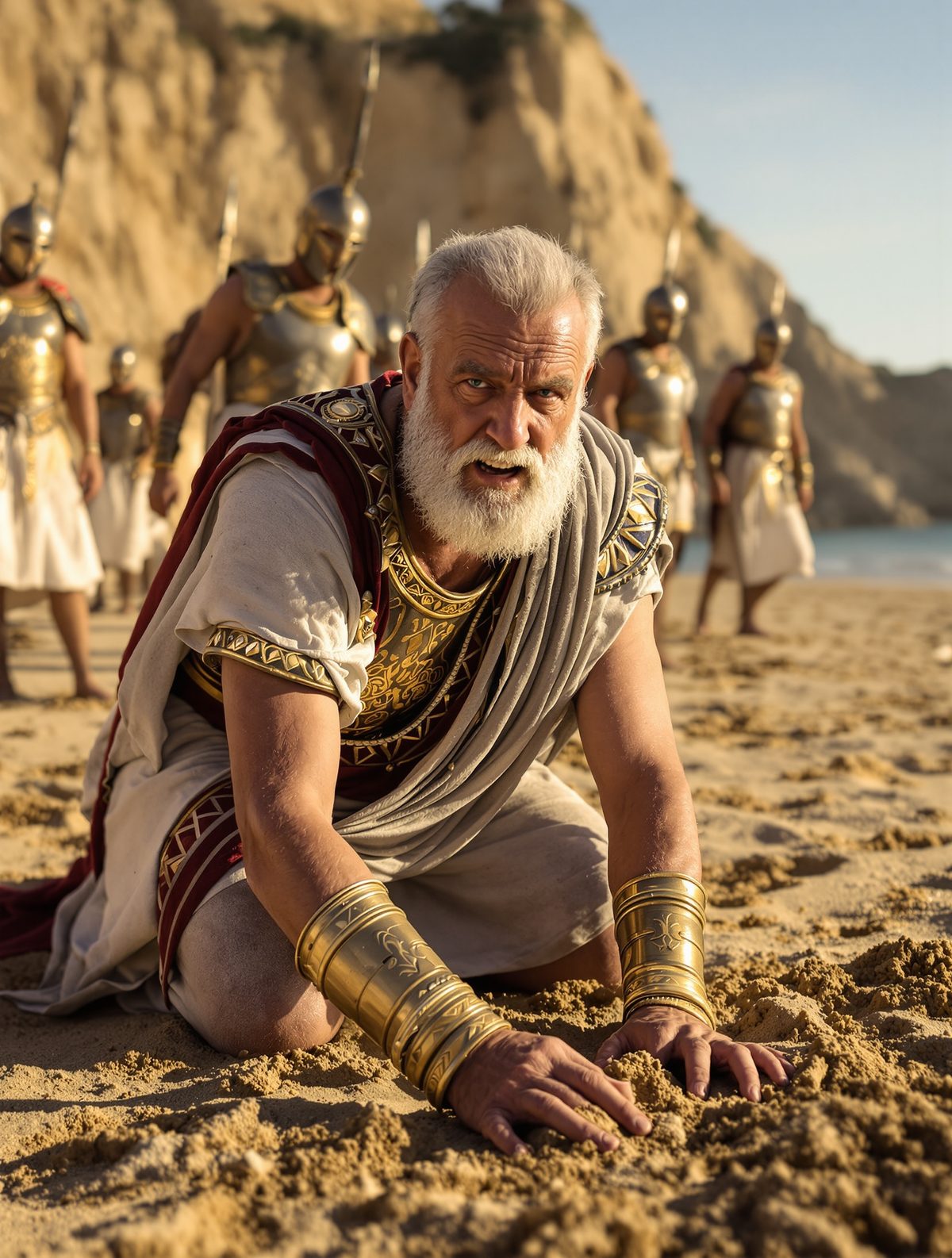
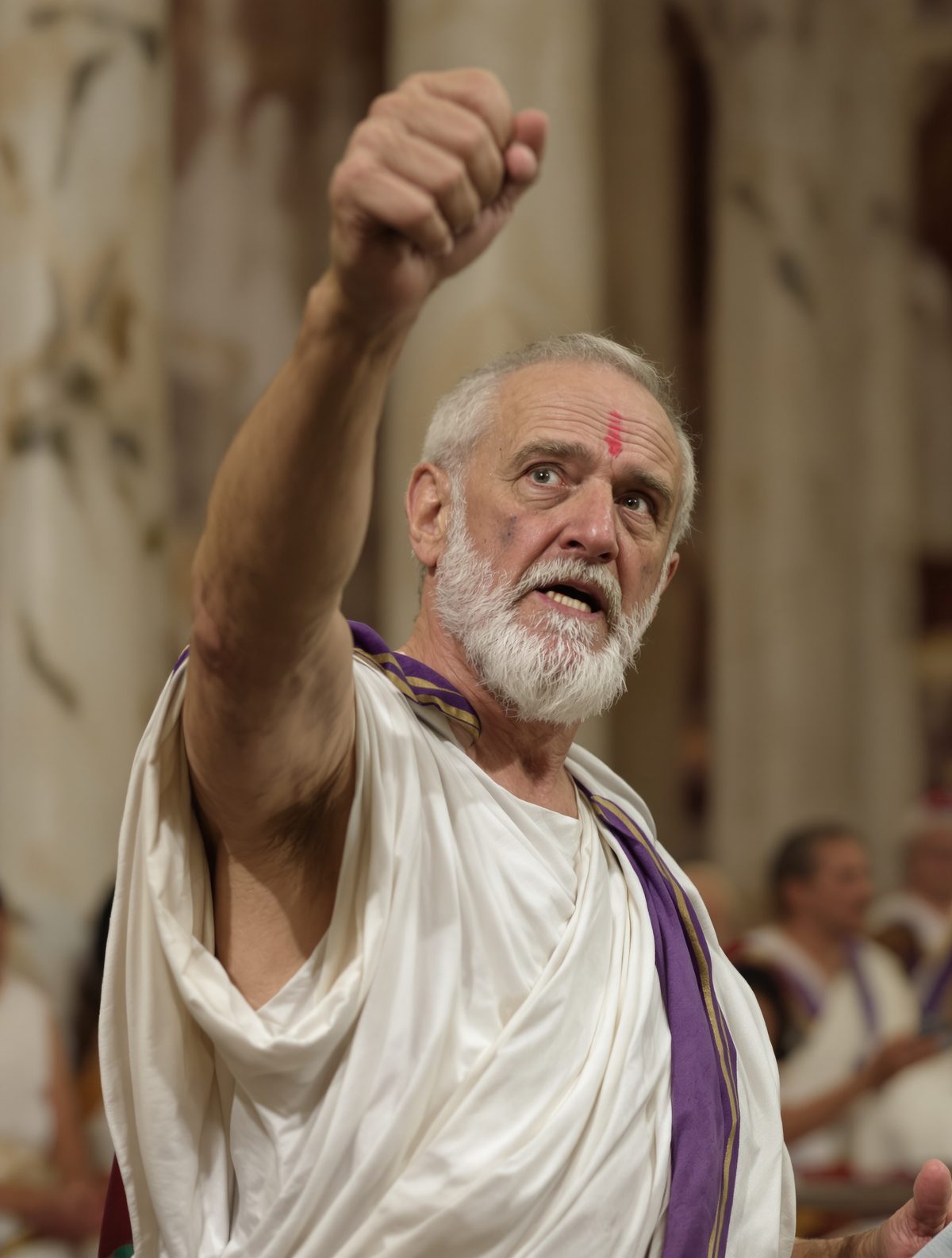
Picture this: You're a Roman senator in 150 BC, gathered in the marble halls of the Curia to debate municipal water rights. The discussion is technical, boring even—until Marcus Porcius Cato rises to speak. The 84-year-old statesman delivers his thoughts on aqueduct maintenance with characteristic precision, then pauses dramatically. His weathered face hardens as he bellows the words that have become his obsession: "Ceterum censeo Carthaginem esse delendam—Furthermore, I think Carthage must be destroyed!"
The senators shift uncomfortably. It's the same ending to every speech, whether Cato is discussing grain subsidies, military budgets, or municipal drainage. For seven relentless years, the most respected voice in Rome has turned every public address into a war cry against a distant city that many Romans had almost forgotten. What drives a brilliant statesman to such apparent madness? The answer lies in a single diplomatic mission that would reshape the ancient world.
The Shock That Changed Everything
In 153 BC, Marcus Porcius Cato embarked on what should have been a routine diplomatic mission to North Africa. Rome had sent a delegation to mediate a border dispute between Carthage and King Massinissa of Numidia—standard peacekeeping business for the emerging Mediterranean superpower. Cato, then 81 and one of Rome's most experienced statesmen, expected to find the broken remnants of a once-great civilization.
What he discovered instead shattered every assumption Rome held about its former enemy. Fifty years after their crushing defeat in the Second Punic War, Carthage had risen like a phoenix from the ashes. The harbor bristled with merchant vessels carrying goods from across Africa and beyond. Construction cranes dotted the skyline as new buildings rose from foundations laid over Hannibal's ruins. Markets overflowed with exotic goods, and the population had swelled to rival Rome itself.
But it wasn't just Carthage's economic recovery that alarmed Cato—it was their military potential. Despite the harsh treaty restrictions imposed after their defeat, the Carthaginians had found creative ways to rebuild their strength. Their citizen militia appeared well-drilled and disciplined. Their fortifications, while officially limited, showed suspicious signs of recent reinforcement. Most troubling of all, Carthaginian leaders spoke with a confidence that bordered on defiance.
Legend claims that Cato was so disturbed by what he witnessed that he began carrying fresh figs in his toga during Senate sessions. "Look at these," he would announce, producing the plump fruit. "These were picked in Carthage just three days ago. That's how close our enemy remains." Whether or not the fig story is true, Cato's message was crystal clear: Carthage was too close, too strong, and too proud to be allowed to exist.
The Birth of an Obsession
From the moment Cato returned to Rome, his mission became singular and consuming. Every appearance in the Senate, every public speech, every casual conversation seemed to circle back to the same terrifying conclusion: Carthage represented an existential threat to Roman civilization. His famous phrase—"Carthago delenda est"—became as predictable as sunrise, yet somehow never lost its ominous power.
What made Cato's campaign so effective wasn't just his persistence, but his reputation. This wasn't some warmongering young senator seeking glory on distant battlefields. Marcus Porcius Cato was Cato the Censor, the moral backbone of Republican Rome. He had earned his stripes fighting Hannibal himself during the darkest days of the Second Punic War. He had served as consul, censor, and elder statesman for over half a century. When Cato spoke, Rome listened—even when they wished he would talk about something else.
His speeches during this period reveal a masterful propagandist at work. Cato didn't simply argue for war; he painted vivid pictures of Roman children enslaved, Roman temples burned, Roman mothers weeping over the graves of their sons. He reminded his audiences of Hannibal's elephants crossing the Alps, of Roman legions slaughtered at Cannae, of Carthaginian armies camping within sight of Rome's walls. "They are the same people," he would thunder, "with the same blood, the same ambitions, the same hatred for everything Roman!"
The Method Behind the Madness
Modern observers might dismiss Cato's repetitive warnings as the ravings of a paranoid old man, but his strategy was brilliantly calculated. In the oral culture of ancient Rome, repetition was power. Important ideas needed to be heard again and again before they took root in the public consciousness. By attaching his anti-Carthaginian message to every conceivable topic, Cato ensured that no Roman politician could escape his influence.
Consider the psychological genius of his approach: senators arriving for debates about taxation or public works knew that regardless of the official agenda, they would hear Cato's warning about Carthage. The constant repetition created a sense of inevitability, as if war with Carthage wasn't a policy choice but a natural law. Younger senators, who had no personal memory of Hannibal's invasion, began to internalize Cato's fears as their own.
Cato also understood the power of contrast. While other speakers droned on about municipal budgets and trade regulations, his speeches crackled with existential urgency. He transformed boring Senate sessions into dramatic performances, complete with visual props (those famous figs), emotional appeals, and stark warnings about Rome's survival. Senators might forget the details of a tax proposal, but they remembered the old man's haunting refrain about Carthaginian destruction.
The timing of Cato's campaign proved equally shrewd. By the 150s BC, Rome had grown comfortable with its Mediterranean dominance. The great wars seemed like ancient history, and many Romans preferred to focus on domestic prosperity rather than foreign threats. Cato's relentless warnings served as an uncomfortable reminder that security was fragile and enemies patient. His message resonated with Romans who remembered their ancestors' stories about nearly losing everything to Carthaginian ambition.
The Tipping Point
For seven years, Cato's warnings fell on increasingly receptive ears, but it took a perfect storm of events to transform his obsession into official policy. In 151 BC, Carthage finally finished paying the massive war reparations imposed after their defeat—fifty years of tribute that had supposedly neutered their military ambitions. Suddenly freed from this financial burden, Carthage began flexing muscles that Romans thought had been permanently severed.
The crisis that sealed Carthage's fate began with King Massinissa of Numidia, Rome's ally and Carthage's neighbor. The cunning king had spent decades nibbling away at Carthaginian territory, confident that Rome's protection made him untouchable. By 150 BC, his provocations had become intolerable. Carthage, no longer bound by tribute payments and facing the loss of vital agricultural land, chose to fight back.
When Carthaginian armies took the field against Massinissa, they technically violated the treaty that ended the Second Punic War. The agreement had forbidden Carthage from waging war without Roman permission—permission that Rome had never granted and never intended to grant. Cato's seven-year campaign had ensured that when this moment arrived, Rome would see it not as a minor border dispute but as proof of Carthaginian treachery.
The Senate's decision for war came swiftly in 149 BC. Cato, now 85 and in declining health, had lived to see his obsession become reality. He died the following year, just as Roman legions landed on the shores of North Africa to begin what history would remember as the Third Punic War. His final victory was also his most complete: Rome wouldn't simply defeat Carthage this time—they would erase it entirely.
The Ultimate Fulfillment
The siege of Carthage lasted three brutal years, from 149 to 146 BC. Roman commanders, fully indoctrinated with Cato's philosophy of total destruction, rejected every Carthaginian attempt at surrender. The city's final assault became one of ancient warfare's most savage episodes, with Roman soldiers fighting house to house through streets slick with blood.
When Carthage finally fell, the Romans implemented Cato's vision with terrifying thoroughness. Survivors were sold into slavery—reportedly 50,000 men, women, and children. The city's buildings were systematically demolished, its harbors filled with rubble, its territories plowed with salt to ensure nothing would ever grow there again. Carthage, which had dominated the Mediterranean for centuries, vanished so completely that later generations would struggle to locate its ruins.
The psychological impact of this obliteration rippled across the ancient world. Rome's message was unmistakable: total resistance meant total destruction. Future enemies would remember Carthage's fate when Roman diplomats arrived with ultimatums. The city's complete erasure became a template for Roman imperial policy, a demonstration that Roman patience, once exhausted, could unleash unprecedented brutality.
Yet even in victory, thoughtful Romans recognized something troubling about what they had accomplished. The historian Polybius reported that Scipio Aemilianus, the general who commanded Carthage's final destruction, wept as he watched the city burn. When asked why, Scipio supposedly replied that he feared Rome might one day suffer the same fate—a remarkably prescient observation given Rome's eventual fall to barbarian invasions.
The Echo Chamber of History
Cato's seven-year campaign against Carthage offers a masterclass in how persistent messaging can reshape political reality. His success wasn't built on new evidence or changed circumstances, but on the relentless repetition of a single, powerful idea. By the time Rome declared war, Carthage's destruction felt inevitable rather than chosen—the natural conclusion to a story that Cato had been telling for nearly a decade.
The parallels to modern political discourse are impossible to ignore. Today's media landscape, with its 24-hour news cycles and social media echo chambers, amplifies the same dynamics that Cato exploited in the Roman Senate. Persistent messaging, repeated across multiple platforms and contexts, can transform fringe ideas into mainstream consensus with frightening speed. The old senator's figs have been replaced by viral videos and targeted advertisements, but the underlying psychology remains unchanged.
Perhaps most troubling is how Cato's success validated the power of fear over reason in political decision-making. His arguments for destroying Carthage weren't based on imminent military threats or aggressive Carthaginian actions, but on the mere possibility of future conflict. By convincing Romans that their former enemy's prosperity itself constituted a danger, Cato pioneered what modern strategists might recognize as preventive warfare—the doctrine that potential threats must be eliminated before they become actual ones.
The complete destruction of Carthage stands as one of history's most successful propaganda campaigns, a testament to how a single obsessed individual can redirect the course of civilizations. Cato's legacy reminds us that the most dangerous political messages aren't always the loudest or most sophisticated—sometimes they're simply the most persistent. In our own age of information warfare and manufactured crises, the old Roman's relentless repetition carries an ominous warning: "Carthago delenda est" became reality not because it was true, but because it was unforgettable.