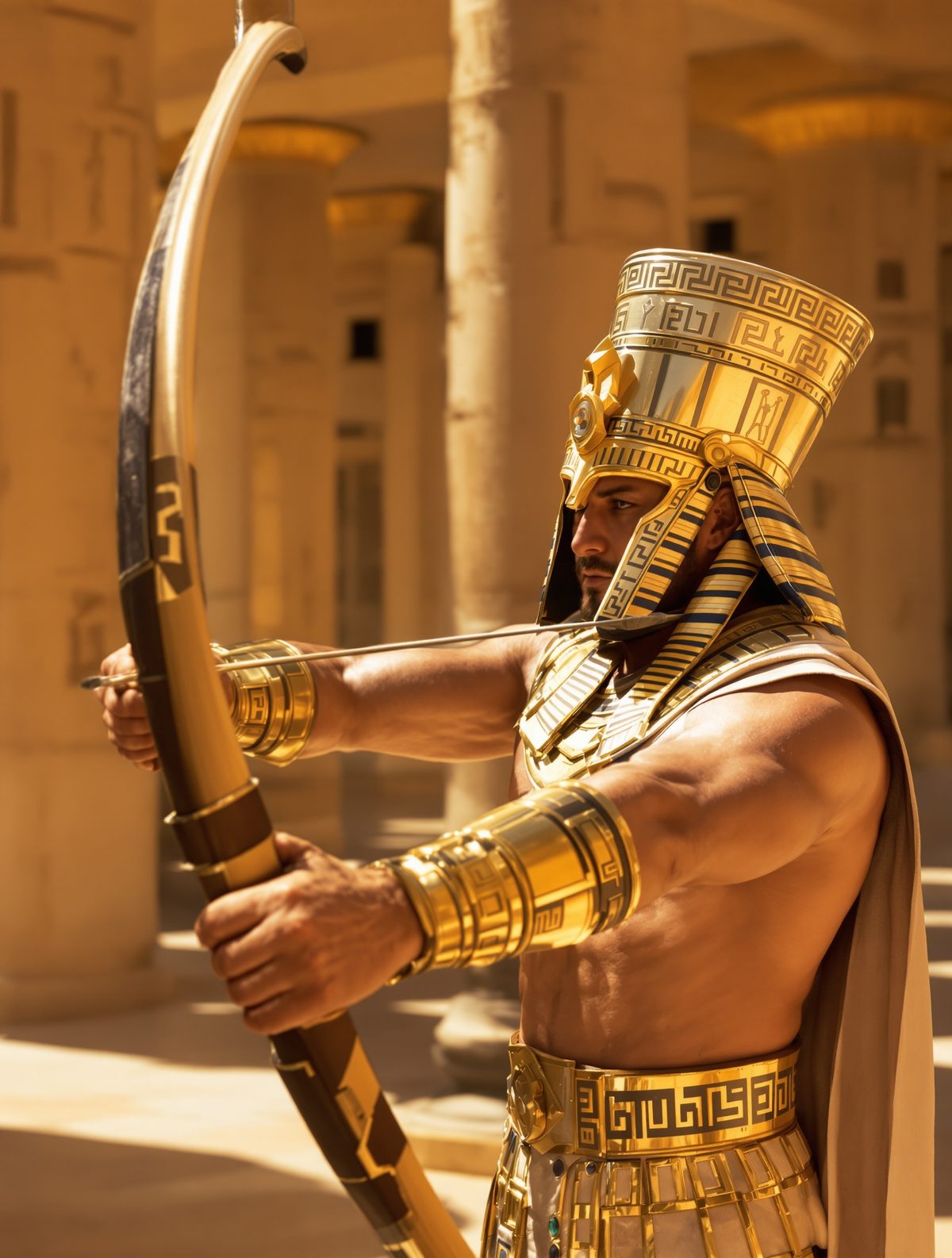
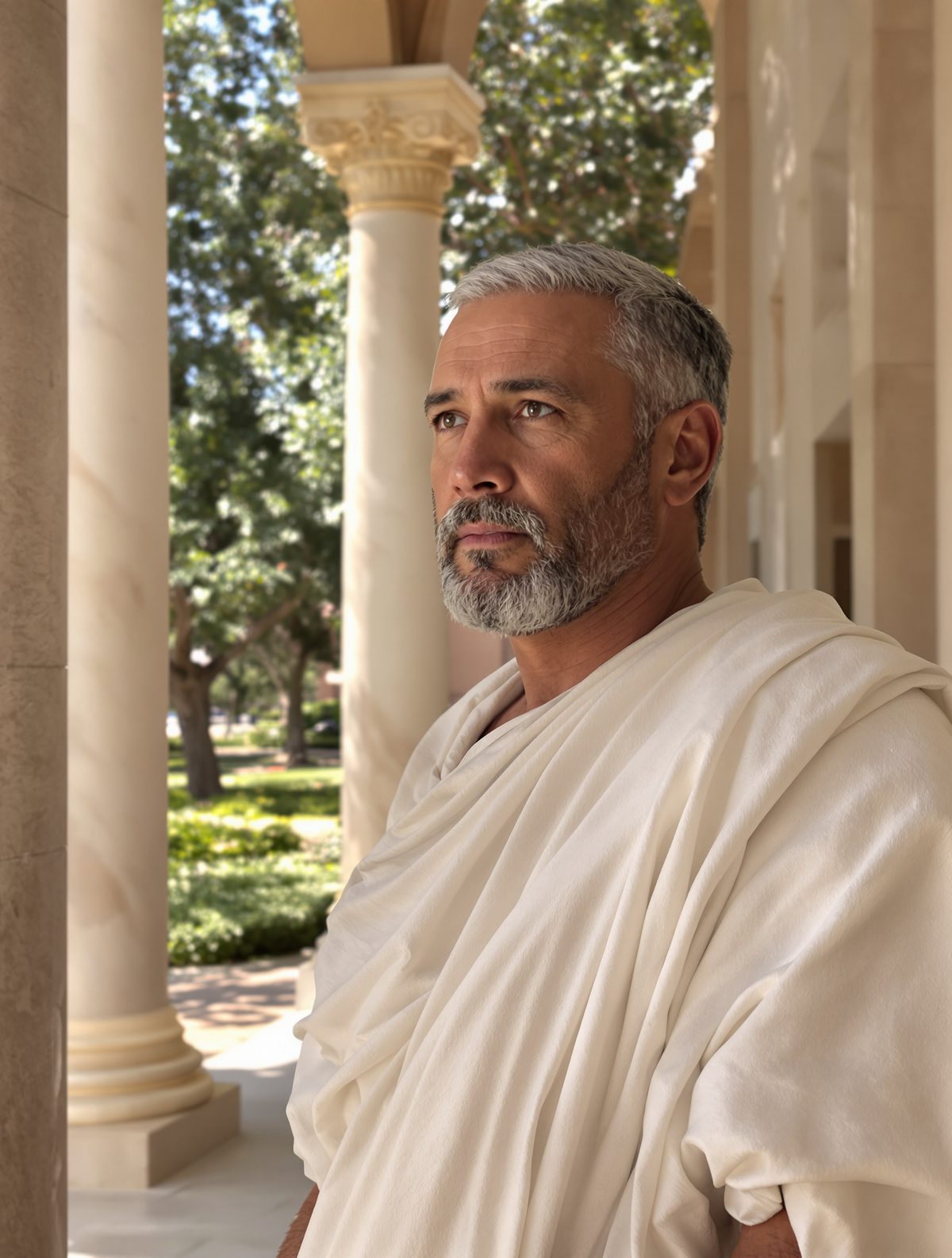
Picture this: It's a sun-drenched afternoon in 460 BC in the Greek colony of Elea, southern Italy. A middle-aged philosopher named Zeno stands before a gathering of his most devoted students, a bow drawn tight in his weathered hands. The arrow sits poised, its bronze tip gleaming in the Mediterranean light. With a sharp twang, he releases it. The projectile streaks across the courtyard, embedding itself in a wooden target with a satisfying thud.
Then Zeno turns to his bewildered audience and, with the calm confidence of a master logician, proceeds to prove mathematically that the arrow never moved at all.
This wasn't theater—it was philosophy at its most mind-bending. Zeno of Elea, a brilliant thinker whose paradoxes would torment the greatest minds for over two millennia, had just demonstrated one of the most famous logical puzzles in human history. His seemingly impossible conclusion? Motion itself is an illusion.
The Disciple Who Outshone His Master
Zeno wasn't working in isolation. He was the star pupil of Parmenides, one of ancient Greece's most influential philosophers, who taught that reality was actually a single, unchanging, eternal substance. According to Parmenides, everything we perceive through our senses—motion, change, multiplicity—was mere illusion. The real universe was motionless and unified.
It was a radical idea that flew in the face of everyday experience, and it attracted fierce criticism from other philosophical schools. That's where Zeno came in. Born around 490 BC, this brilliant defender of his teacher's ideas didn't just argue—he created logical traps so ingenious they're still studied today. His method was devastatingly simple: assume the opposite of what Parmenides taught, then follow the logic to an absurd conclusion.
Ancient sources credit Zeno with crafting roughly forty of these paradoxes, though only a handful survive today. But what survivors they are. Aristotle himself called Zeno "the inventor of dialectic"—the art of argument through contradiction. Here's a lesser-known fact: Zeno may have been the first person in history to use what we now call "proof by contradiction," a technique that remains fundamental to mathematics.
The Arrow That Never Flew
The Arrow Paradox, arguably Zeno's most famous creation, works like this: At any given instant in time, the flying arrow occupies a specific position in space. In that instant—which has no duration—the arrow cannot move, because motion requires time to pass. Since the arrow's flight consists entirely of such instants, and it cannot move during any individual instant, it can never actually move at all.
Imagine trying to explain this to those students in ancient Elea. They've just watched an arrow sail through the air with their own eyes, yet their beloved teacher has just "proved" it was motionless the entire time. The paradox cuts to the heart of how we understand time, space, and motion—concepts so fundamental we rarely question them.
But Zeno wasn't finished. He had three other motion paradoxes that were equally mind-bending. In the famous "Achilles and the Tortoise," he proved that the fastest runner in Greek mythology could never overtake a plodding reptile, provided the tortoise had a head start. Every time Achilles reached the tortoise's previous position, the creature would have moved slightly ahead, creating an infinite series of gaps to close.
The Mathematics of the Impossible
What made Zeno's paradoxes so compelling wasn't just their logical structure—it was their mathematical precision. The Achilles paradox, for instance, involves what we now recognize as an infinite geometric series. If the tortoise starts 100 meters ahead and moves at one-tenth Achilles' speed, then by the time Achilles covers 100 meters, the tortoise is 10 meters ahead. When Achilles covers those 10 meters, the tortoise is 1 meter ahead, and so on: 100 + 10 + 1 + 0.1 + 0.01...
Here's what's fascinating: Zeno was grappling with concepts that wouldn't be formally solved until the development of calculus in the 17th century, over 2,000 years later. The Greek mathematicians of his era lacked the tools to handle infinite series, making his paradoxes genuinely unsolvable puzzles that haunted intellectual discourse for millennia.
Medieval Islamic scholars wrestled with Zeno's ideas. European philosophers during the Renaissance found themselves equally stumped. Even Galileo, the father of modern physics, struggled with the implications. It wasn't until mathematicians like Newton and Leibniz developed the mathematical machinery to sum infinite series that Zeno's paradoxes could be properly addressed—and even then, they raised new questions about the nature of space and time.
The Genius of Ancient Argument
But here's a detail they don't teach in philosophy classes: Zeno probably didn't believe his own paradoxes proved motion was impossible. Ancient sources suggest he was playing a deeper game—a master logician demonstrating the power of rigorous reasoning to expose hidden contradictions in seemingly obvious truths.
Plato described Zeno as "the Eleatic Palamedes," comparing him to the Greek hero renowned for his cunning intelligence. In Plato's dialogue Parmenides, Zeno explains that his paradoxes were written as a kind of intellectual revenge, defending his teacher by showing that those who mocked the idea of a motionless universe faced even greater absurdities when they tried to defend the reality of motion and change.
The historical Zeno was apparently as formidable in person as his arguments were on papyrus. According to later accounts, he was tortured and executed around 430 BC for plotting against the tyrant of Elea. Legend has it that under torture, he bit off his own tongue and spat it at his captor rather than reveal his conspirators' names. Whether true or not, the story captures something essential about the man: his absolute commitment to the power of reasoned argument over brute force.
When Ancient Puzzles Meet Modern Physics
The most remarkable twist in Zeno's story came in the 20th century, when quantum mechanics revealed that reality might be stranger than even he imagined. Modern physics suggests that at the quantum level, particles don't have definite positions and velocities simultaneously—an idea that would have delighted the ancient philosopher who argued that motion was paradoxical.
Einstein's theory of relativity, meanwhile, revealed that time itself is relative and can dilate or contract depending on motion and gravity. Space and time, those seemingly absolute backdrops against which Zeno staged his paradoxes, turned out to be far more flexible than anyone in ancient Greece could have imagined.
Some interpretations of quantum mechanics even suggest that reality consists of discrete, indivisible moments—quantum "time atoms" that might resolve Zeno's Arrow Paradox in ways the ancient philosopher could never have anticipated. The arrow moves because reality itself unfolds in discrete quantum steps, not the smooth, continuous flow our senses suggest.
Today, Zeno's paradoxes remain relevant in computer science, where they help illuminate the challenges of modeling continuous motion in discrete digital systems. Video game designers and animation programmers regularly encounter Zeno-like problems when trying to create smooth, realistic motion on screens that update in discrete frames.
The Eternal Questions
Perhaps the most profound lesson of Zeno's paradoxes isn't their solution, but their persistence. For over 2,500 years, they've forced humanity's greatest thinkers to question assumptions so basic we rarely notice them. What is time? What is space? How do we bridge the gap between our direct sensory experience and the abstract mathematical descriptions we use to understand reality?
Zeno of Elea never claimed to have final answers to these questions. Instead, he gave us something more valuable: the intellectual tools to keep asking them with precision and rigor. In an age where information travels faster than ever but wisdom sometimes seems in short supply, Zeno's example reminds us that the most important questions are often the ones that seem too obvious to ask.
The next time you watch an arrow fly—or a ball roll across a field, or a car drive down the street—remember the ancient philosopher who stood in a sun-drenched courtyard and dared to suggest that what we see might not be what we get. In questioning motion itself, Zeno set in motion an intellectual journey that continues to this day, proving that sometimes the most revolutionary act is simply asking "But wait—how do we really know that's true?"