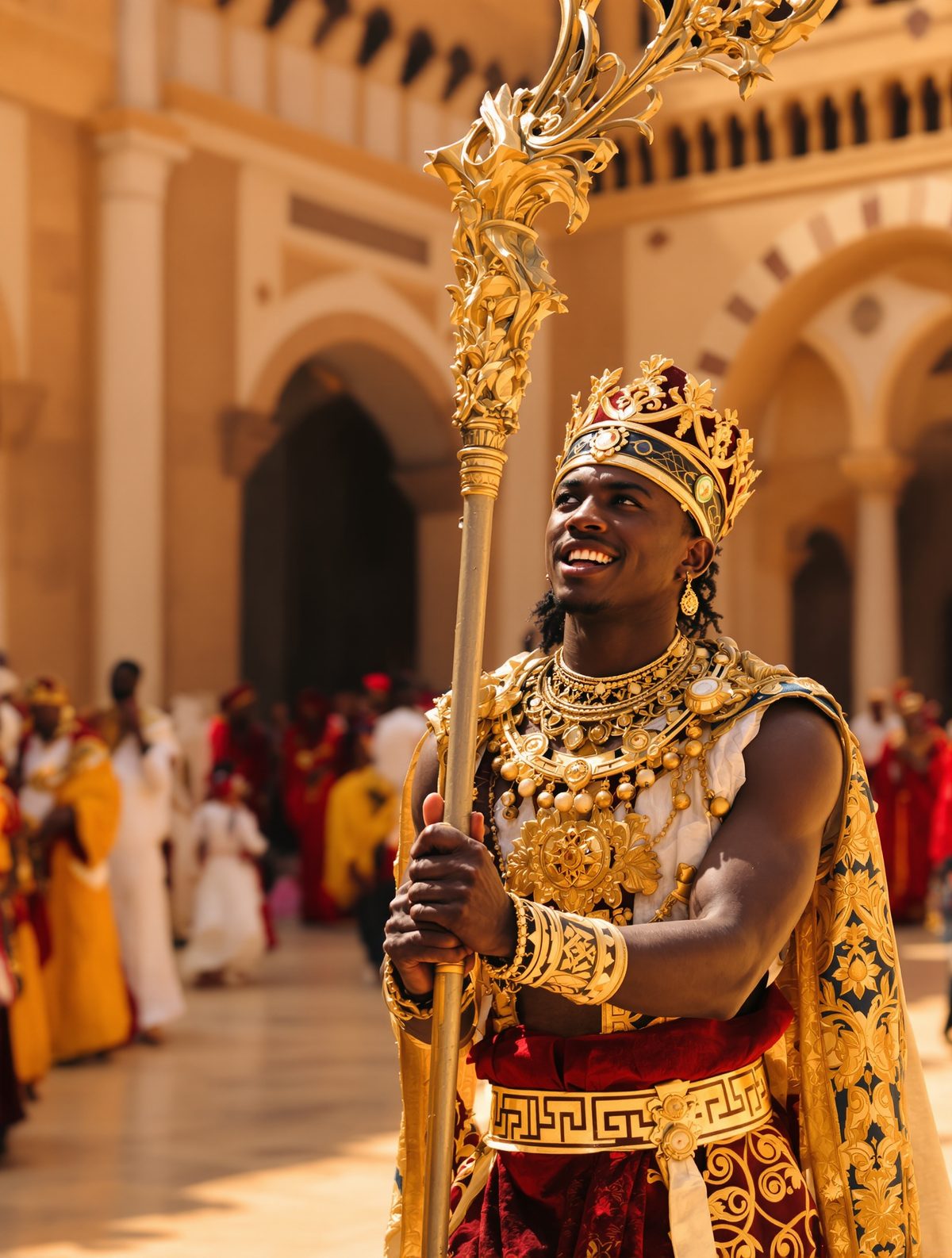
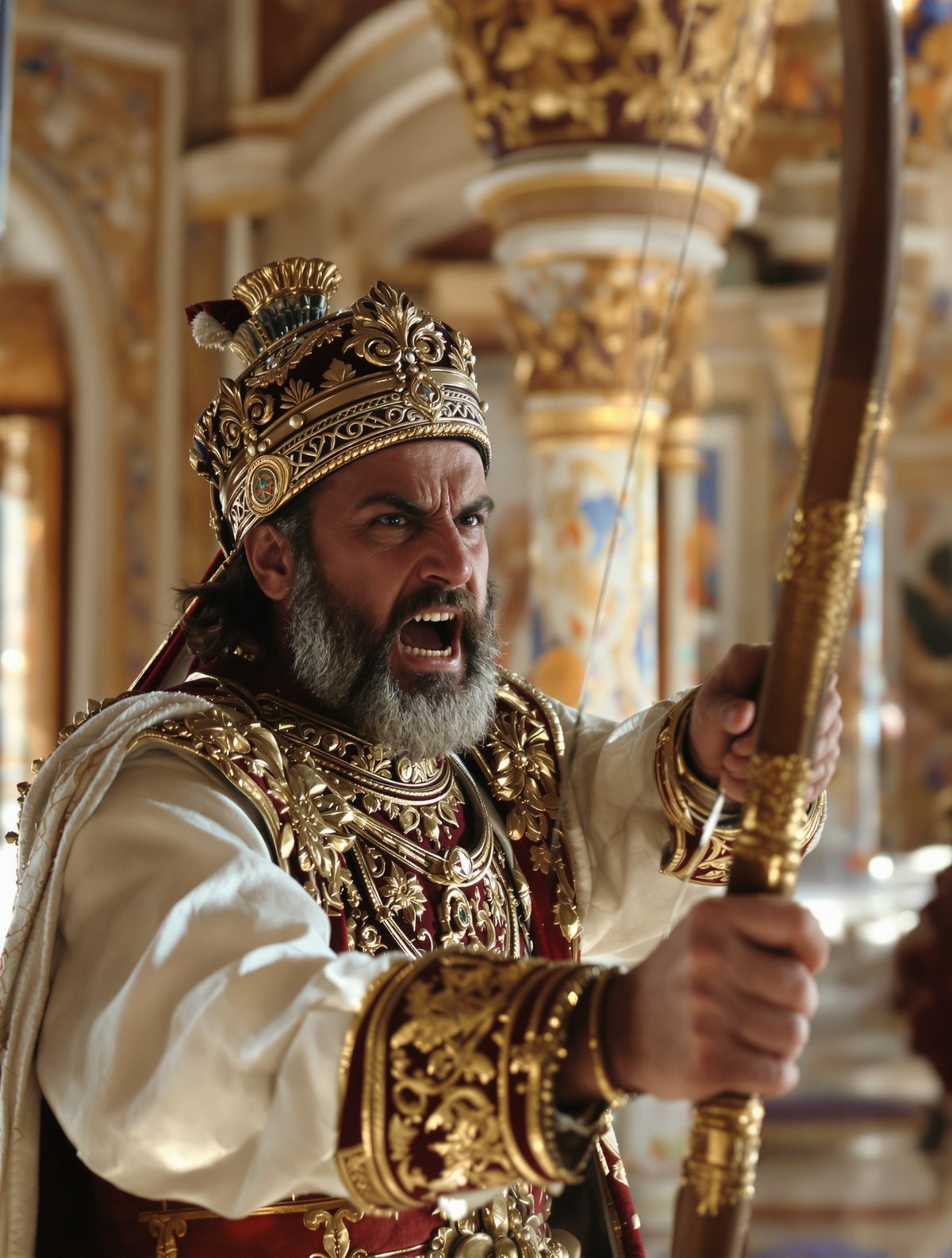
The bowstring trembled in the morning light as Prexaspes drew back the arrow, its bronze tip glinting in the Persian sun. Before him stood his own son—young, innocent, and utterly unaware that he was about to become the ultimate test of his father's loyalty to a mad king. This wasn't a hunting expedition or military training. This was King Cambyses II's twisted proof that he remained perfectly sane, even as his empire whispered otherwise behind palace walls.
In the blood-soaked annals of ancient Persia, few tales capture the horrifying intersection of absolute power and human cruelty quite like this one. It's a story that reveals how paranoia can transform trusted advisors into instruments of their own torment, and how the pursuit of proving one's sanity can become the very evidence of its absence.
The Mad King's Paranoia Takes Root
By 522 BC, Cambyses II had already carved out a reputation as one of history's most unpredictable rulers. The son of Cyrus the Great, he had inherited not just the vast Persian Empire but also the crushing weight of living up to his legendary father's achievements. While Cyrus had been remembered for his wisdom and mercy—famously freeing the Jewish exiles in Babylon—Cambyses would be remembered for something else entirely.
The whispers had started in the corridors of Persepolis months earlier. Courtiers, speaking in hushed tones behind marble columns, began questioning their king's mental state. Cambyses had recently returned from his conquest of Egypt, where his behavior had grown increasingly erratic. He had reportedly killed the sacred Apis bull of Memphis, stabbed a judge for accepting bribes, and ordered the execution of his own brother Bardiya on suspicion of treason.
But it was his treatment of those closest to him that truly alarmed the court. The king had married his own sister—a practice unheard of even in royal Persian circles—and when she questioned one of his decisions, he had kicked her so violently that she miscarried and died. These weren't the actions of the calculated conqueror who had successfully added Egypt to the Persian Empire. These were the actions of a man losing his grip on reality.
Prexaspes: The Archer Caught Between Truth and Survival
Among those who witnessed Cambyses' descent into madness was Prexaspes, a man who held one of the most prestigious yet dangerous positions in the ancient world: the king's trusted confidant. As royal messenger and master archer, Prexaspes had spent years at Cambyses' side, delivering the king's words to distant satrapies and demonstrating the legendary accuracy that made Persian archers the terror of battlefields from India to Ethiopia.
Prexaspes possessed something that made him invaluable to any ruler—he was completely honest. In a court filled with sycophants eager to tell the king what he wanted to hear, Prexaspes had built his reputation on delivering uncomfortable truths. It was a quality that had served him well under the reasonable rule of Cyrus, but under Cambyses, it was becoming a liability.
The fatal conversation occurred during one of the king's frequent wine-soaked evenings. According to the Greek historian Herodotus, who recorded this tale decades later, Cambyses had been drinking heavily when he turned to his most trusted advisor with a question that seemed innocent enough: "What do the Persians think of me?"
A wise courtier would have offered flowery praise about the king's wisdom and strength. Prexaspes, true to his character, told the truth. The Persians, he said, thought highly of their king in most respects, but they believed he was too fond of wine. Some, he admitted, were even beginning to question whether the drink was affecting the king's judgment.
When Honesty Becomes a Death Sentence
The words hung in the air like poison. Cambyses' face darkened as he processed what his most loyal advisor had just revealed. The king's paranoia, already simmering beneath the surface, exploded into rage. If his own people thought him mad, then everyone around him must be spreading lies. And if Prexaspes was reporting such rumors, then surely he believed them himself.
"So the Persians think I'm mad, do they?" Cambyses reportedly snarled. "And what do you think, Prexaspes? Do you believe your king has lost his mind?"
The archer found himself trapped in an impossible position. Deny the rumors too forcefully, and he would appear to be lying—something Cambyses would surely detect. Admit to any doubts about the king's sanity, and he would be signing his own death warrant. But Cambyses wasn't finished. In his twisted logic, the king had devised what he believed to be the perfect test of both his own mental faculties and his archer's loyalty.
"I'll prove to you just how sane I am," the king declared with chilling calm. "And you, my faithful Prexaspes, will help me demonstrate the steadiness of my judgment and the precision that runs in Persian blood."
The Ultimate Test of Loyalty and Skill
What happened next would echo through history as one of the most chilling examples of absolute power corrupting absolutely. Cambyses ordered that Prexaspes' young son—described by historians as a promising youth in his teens—be brought to the courtyard. The boy arrived, likely expecting some honor or recognition, unaware that his father's honesty had sealed his fate.
The king's logic was as twisted as it was cruel. If he could direct Prexaspes to shoot an arrow that would strike the boy's heart with perfect precision, it would prove two things: first, that the king's mind was sharp enough to devise such a test, and second, that his judgment in choosing and training archers was flawless. A madman, Cambyses reasoned, could never orchestrate such a display of skill and control.
The historical accounts vary on the exact details, but the core elements remain consistent across sources. The young man was positioned at a considerable distance—some accounts suggest it was the length of a Persian archery range, roughly 100 paces. Prexaspes was handed his bow, the same weapon with which he had served his king faithfully for years, now transformed into an instrument of unthinkable cruelty.
The courtyard fell silent. Palace guards, servants, and nobles watched in horror as they realized what they were about to witness. The boy himself may not have fully understood until the final moments, trusting that his father—renowned throughout the empire for his skill—would somehow find a way to spare him.
The Arrow That Pierced More Than Flesh
Prexaspes drew the bowstring back, his hands steady despite the enormity of what he was being forced to do. In those final seconds, a thousand thoughts must have raced through his mind. He could refuse, certainly, but that would mean death for both himself and his son—and likely his entire family. He could deliberately miss, but Cambyses would see through such deception immediately, and the consequences would be even worse.
The arrow flew true.
When the king's servants retrieved the body and cut open the chest, they found the bronze arrowhead lodged precisely in the heart. Cambyses erupted in triumphant laughter. "Now tell me," he crowed to the assembled court, "whether any madman could have shot so truly! Have you ever seen such perfect aim?"
But the king's satisfaction was not complete. Turning to the man who had just murdered his own child on royal command, Cambyses demanded validation. "Now, Prexaspes," he said, "do you still think I'm mad?"
The broken father, standing over his son's corpse, could only whisper his response: "No, my lord. Not even a god could shoot so accurately."
The Price of Speaking Truth to Power
This horrific tale, preserved primarily through Herodotus's Histories, serves as more than just a shocking anecdote from the ancient world. It reveals the fundamental dangers that arise when absolute power meets unchecked paranoia, and when the truth becomes a liability rather than a virtue.
Prexaspes would survive this ordeal, continuing to serve Cambyses until the king's death later that same year during a military campaign. Ironically, when Cambyses died under mysterious circumstances—possibly by suicide after accidentally wounding himself with his own sword—it was Prexaspes who became instrumental in the succession crisis that followed. The man who had been forced to prove his loyalty through filicide would later help expose the false Bardiya (actually a Magian named Gaumata) who had seized the throne, paving the way for Darius I to become king.
But perhaps the most chilling aspect of this story is how it demonstrates that even in the ancient world, people recognized the profound connection between truth, power, and madness. Cambyses' need to prove his sanity through an act of spectacular cruelty became, paradoxically, the strongest evidence of his insanity. No rational ruler would devise such a test. No stable mind would find validation in forcing a loyal subject to murder his own child.
In our modern age of political polarization and social media echo chambers, the tale of Prexaspes and his son offers a sobering reminder of what happens when leaders become more concerned with silencing uncomfortable truths than addressing them. The archer's honesty, which should have been valued as a precious gift in a world full of flatterers, instead became a death sentence for his child. It's a lesson that resonates across millennia: when speaking truth to power becomes dangerous, everyone—rulers and subjects alike—ultimately pays the price.