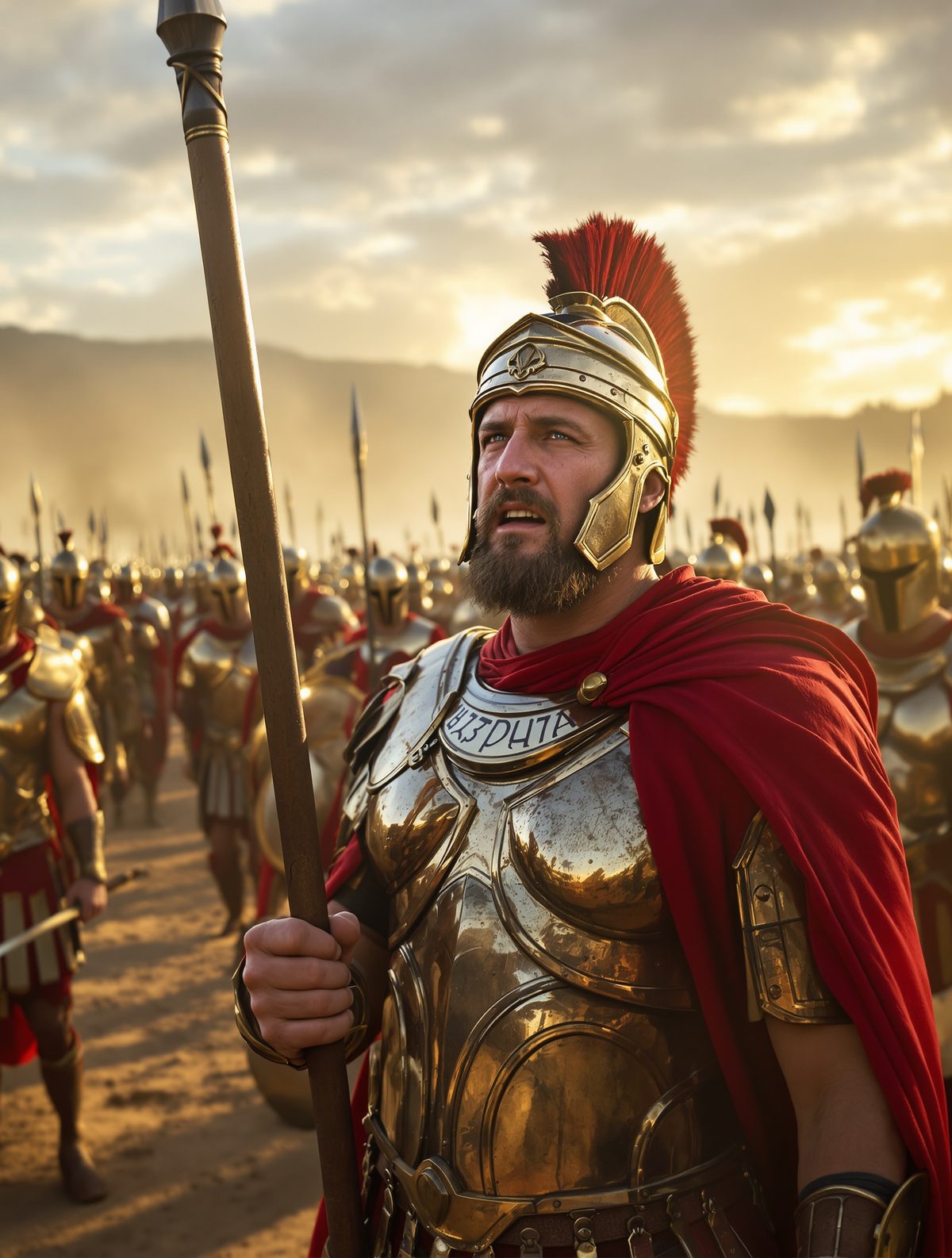
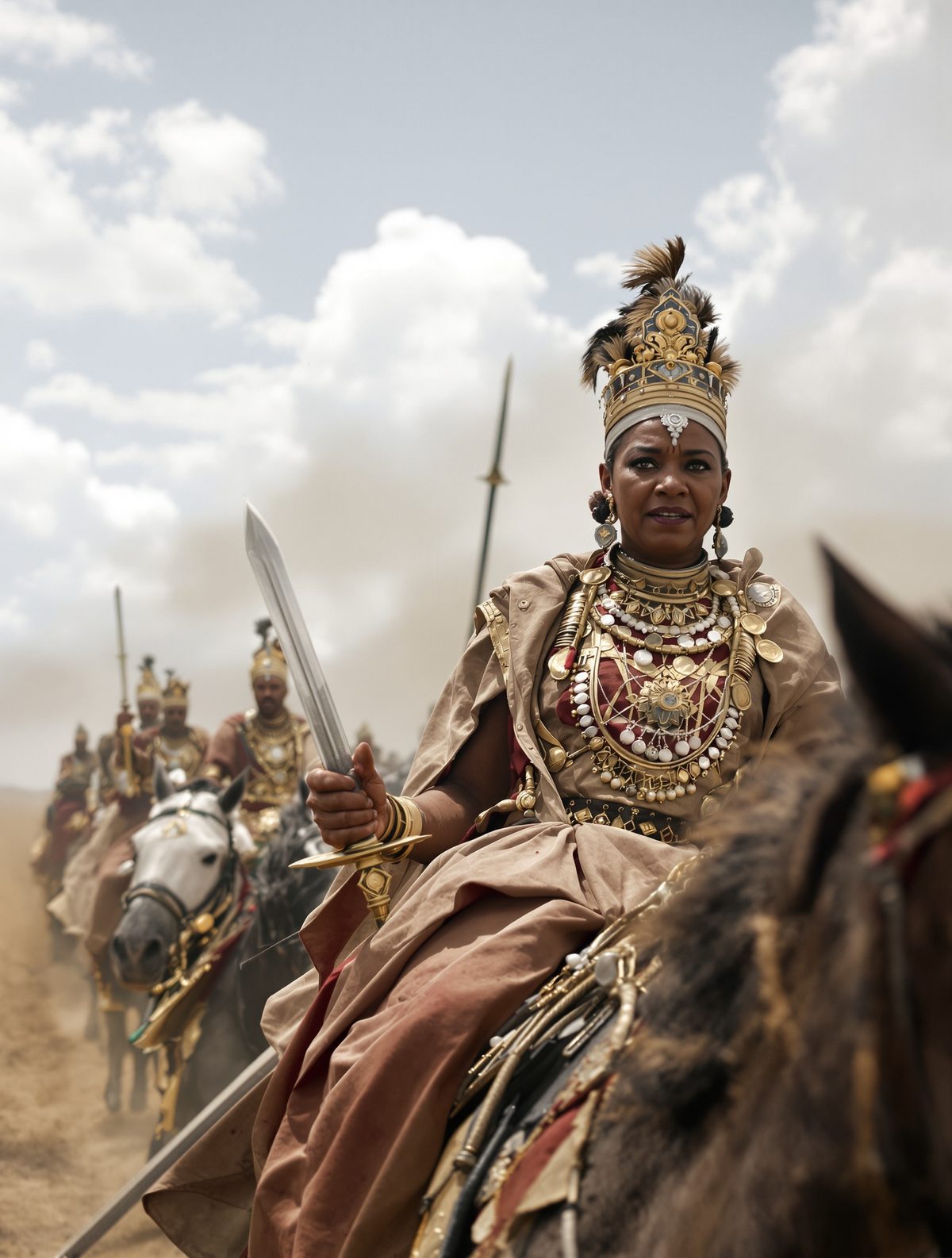
Picture this: Portuguese soldiers, trained in European warfare and armed with the latest muskets, fleeing in terror across the African savanna. Behind them thunders a cavalry charge led not by some young warrior king, but by a 60-year-old grandmother with silver hair streaming behind her and a sword glinting in the sun. This wasn't supposed to happen. European conquistadors had carved up most of the world by 1640, but they hadn't met Queen Nzinga of Ndongo and Matamba.
For three decades, this remarkable woman would turn the tables on colonial conquest, proving that sometimes the most dangerous opponent is the one who refuses to play by your rules.
The Diplomat Who Refused to Kneel
Anna Nzinga's legend began long before she ever drew a sword. Born around 1583 into the royal family of Ndongo (in present-day Angola), she first stunned Europeans with her diplomatic prowess, not her military might. In 1622, when she was nearly 40, her brother King Ngola Mbandi sent her to negotiate with Portuguese Governor João Correia de Sousa in Luanda.
The Portuguese had set up the meeting as a power play. They provided only one chair – for the governor – forcing Nzinga to stand like a supplicant. But Nzinga had other plans. She calmly gestured to one of her servants, who immediately dropped to hands and knees. The future queen sat regally on her human throne and conducted the entire negotiation as an equal.
That single act revealed everything about Nzinga's character: her intelligence, her refusal to be diminished, and her absolute mastery of political theater. The Portuguese were dealing with someone unlike any African ruler they'd encountered. She spoke Portuguese fluently, understood European military tactics, and had even converted to Christianity (taking the name Anna after the Portuguese governor's wife). But beneath this diplomatic sophistication lay the heart of a warrior.
A Crown Claimed in Blood
When King Mbandi died mysteriously in 1624 – with many suspecting Nzinga herself had poisoned him – she moved swiftly to claim power. This wasn't simply ambition; it was survival. Portuguese slave raids were devastating her people, and weak leadership meant extinction. At 41, Nzinga declared herself Queen of Ndongo, breaking centuries of tradition that reserved rule for men.
The Portuguese initially tried to work with her, but Nzinga proved impossible to control. She harbored escaped slaves, welcomed Portuguese military deserters who brought valuable intelligence about European tactics, and most infuriatingly, she treated captured Portuguese soldiers as prisoners of war rather than executing them – a psychological warfare tactic that unnerved colonial authorities who expected African "savagery."
By 1626, the Portuguese had had enough. They installed a puppet ruler and declared Nzinga illegitimate. Their mistake was assuming she would retreat into exile like a proper deposed monarch. Instead, she began planning the most audacious military campaign in 17th-century Africa.
The Grandmother General Takes the Field
In 1630, at age 47, Nzinga conquered the kingdom of Matamba and established it as her new base of operations. But her real military genius emerged in the 1640s when major Portuguese reinforcements arrived in Angola. Rather than hiding behind palace walls, this 60-year-old queen personally took to the battlefield.
Portuguese chroniclers, writing with barely concealed terror and grudging admiration, described a woman who fought "like a man in her passion and cruelty." She wielded weapons with deadly skill, understood battlefield tactics better than most generals, and possessed an almost supernatural ability to inspire loyalty in her troops.
What made Nzinga's military campaigns so effective wasn't just her personal courage – it was her strategic brilliance. She had studied European warfare for decades, understanding that Portuguese strength lay in their fortified positions and firearms, while their weakness was mobility. So she refused to fight European-style battles. Instead, she perfected a devastating combination of guerrilla tactics and lightning cavalry strikes that kept Portuguese forces constantly off-balance.
Her armies moved like ghosts across the landscape, appearing suddenly to strike Portuguese supply lines, then vanishing before reinforcements could arrive. And leading every major assault was Nzinga herself, gray-haired and grandmotherly, but absolutely terrifying with a blade in her hand.
The Art of Impossible War
From 1640 to 1670, Nzinga waged what should have been an impossible war. The Portuguese had superior weapons, European military advisors, and seemingly unlimited reinforcements from Brazil. Nzinga had clever tactics, fierce determination, and something the Portuguese couldn't comprehend: she was fighting for her people's survival, not profit.
Her military innovations were remarkable. She created an army that combined traditional African warriors with escaped slaves who understood Portuguese tactics, deserters who brought European military knowledge, and even Dutch allies who provided firearms (the Dutch and Portuguese were competing for control of African trade routes). This multicultural force, united under Nzinga's charismatic leadership, consistently outmaneuvered larger Portuguese armies.
Most shocking to European sensibilities was Nzinga's personal involvement in combat. At an age when most European queens were content with ceremonial roles, she was leading cavalry charges and engaging in personal combat. Portuguese reports describe her fighting in 1648 at age 65, still personally leading assaults and inspiring her troops through example rather than speeches.
The psychological impact on Portuguese forces cannot be overstated. These were men raised to believe in European military superiority and African inferiority, yet they found themselves consistently defeated by an elderly African woman who seemed to anticipate their every move.
More Than a Warrior
What's often overlooked in tales of Nzinga's military prowess is her skill as a ruler and social revolutionary. She transformed Matamba into a haven for escaped slaves, creating what was essentially the largest maroon community in Africa. Her kingdom welcomed people regardless of their origins – former slaves worked alongside traditional nobles, Portuguese deserters trained African soldiers, and Dutch traders found safe harbor.
She also revolutionized gender roles in her society. Nzinga surrounded herself with female bodyguards, appointed women to high military positions, and even reportedly kept a harem of men who dressed as women (though this detail may have been European propaganda designed to scandalize Christian readers). Whether true or not, such stories reinforced her image as someone who refused to accept anyone's limitations.
Perhaps most remarkably, she maintained this complex kingdom while simultaneously waging a 30-year war. She negotiated treaties, managed trade relationships, dispensed justice, and planned military campaigns well into her 70s. When she finally agreed to a peace treaty with Portugal in 1657, she was 74 years old and still sharp enough to secure favorable terms.
The Legacy of an Unlikely Conqueror
Queen Nzinga died peacefully in 1663 at age 80, having achieved something remarkable: she had fought the Portuguese Empire to a standstill and secured her people's independence for generations. Her kingdom of Matamba would remain free from Portuguese control until the late 19th century – nearly 200 years after her death.
But perhaps more importantly, she shattered assumptions about what was possible. In an era when Europeans viewed Africans as inherently inferior and women as inherently weak, Nzinga proved that intelligence, determination, and tactical brilliance could overcome seemingly impossible odds. She demonstrated that a small kingdom could resist a global empire, that guerrilla tactics could defeat superior technology, and that leadership came from character, not gender or age.
Today, as we watch conflicts around the world where small nations face overwhelming odds, or as we debate what leadership looks like in the 21st century, Nzinga's example remains startlingly relevant. She reminds us that the most dangerous opponent is often the one who refuses to accept defeat, who adapts rather than surrenders, and who leads by example rather than expectation.
The Portuguese came to Angola expecting to face another African army. Instead, they discovered that sometimes the most formidable enemy is a 60-year-old grandmother who simply refuses to lose.