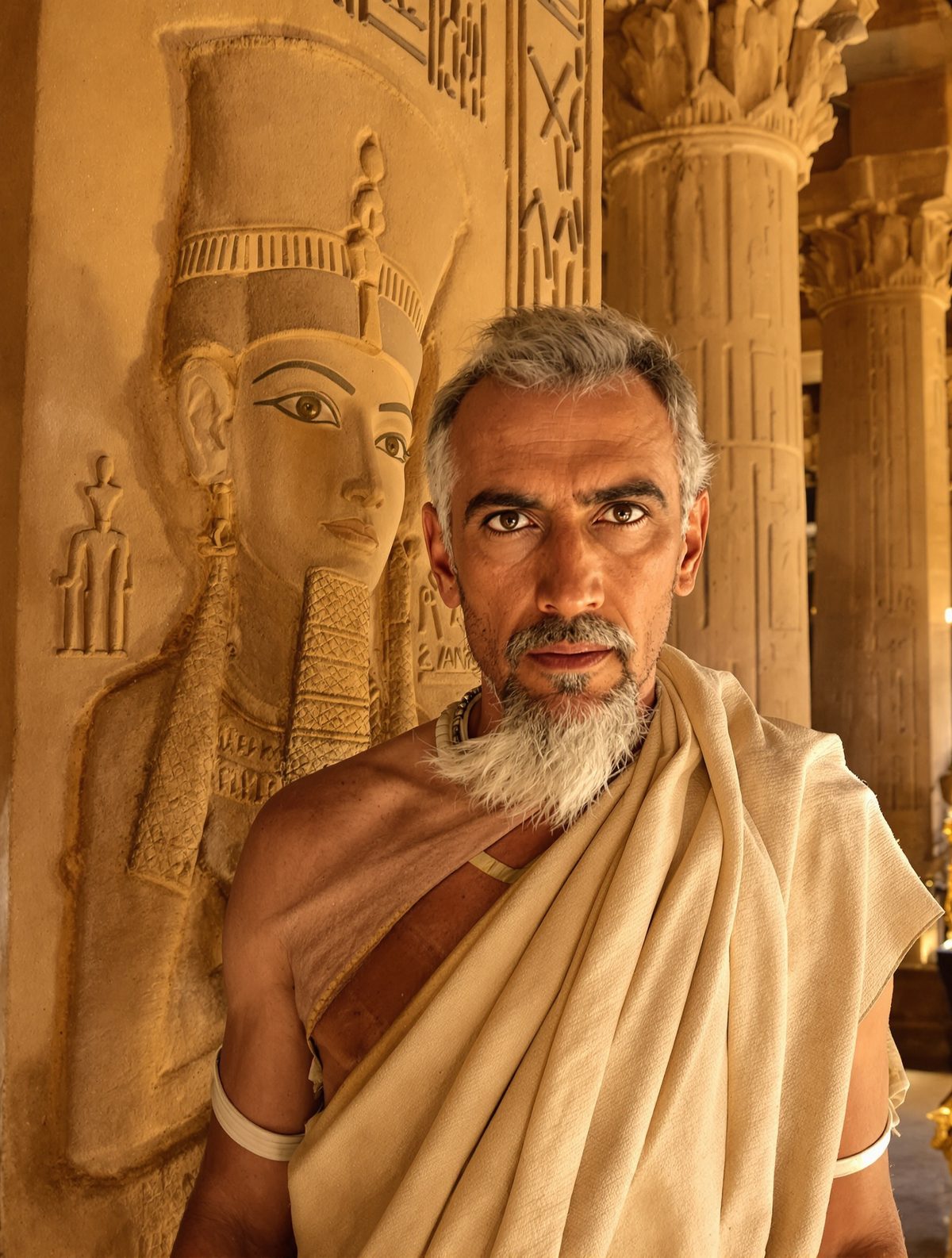
Picture this: In the shadows of ancient Egypt's most magnificent temple, behind massive cedar doors that weigh more than a modern car, a man's face stares out from stone. For over 3,400 years, this hidden portrait has watched in darkness, waiting for those rare moments when the temple doors swing shut and he can gaze upon the sacred space he created for the woman he may have loved. This is the story of Senenmut—royal architect, possible lover, and the man who risked everything to ensure he could watch over his queen for eternity.
The Queen Who Became King
To understand Senenmut's breathtaking act of devotion, we must first meet the remarkable woman who inspired it. Hatshepsut wasn't supposed to rule Egypt. When her husband Thutmose II died around 1479 BC, the throne should have passed to his son by another wife—the future Thutmose III, who was still just a child. Hatshepsut was meant to serve as regent until the boy came of age.
Instead, she did something unprecedented. Around the seventh year of her regency, Hatshepsut declared herself pharaoh. Not content to rule from the shadows, she donned the false beard of kingship, bound her breasts, and took on the full regalia of divine rulership. For nearly two decades, she would reign as one of Egypt's most successful pharaohs, bringing peace and prosperity that her male successors could only dream of matching.
But even the most powerful woman in the ancient world needed someone she could trust completely. Enter Senenmut—a man of humble origins who would become the architect of her greatest monument and keeper of her most intimate secrets.
From Nobody to Master Builder
Senenmut's rise reads like an ancient Egyptian fairy tale, if fairy tales included massive construction projects and political intrigue. Born to commoners named Ramose and Hatnofer in the town of Armant, he possessed no noble blood, no inherited wealth, and no obvious path to power. What he did have was an brilliant architectural mind and an uncanny ability to win Hatshepsut's trust.
The exact nature of their relationship remains one of history's most tantalizing mysteries. Official records describe him with an unprecedented collection of titles: "Chief Architect," "Overseer of All Works of the King," and most tellingly, "He who is in the confidence of the King." Some scholars believe he may have been Hatshepsut's lover; others argue he was simply her most trusted advisor. What's undeniable is that she granted him privileges no commoner had ever received.
Hatshepsut allowed Senenmut to build his own tomb in the Valley of the Kings—sacred ground reserved for royalty. She permitted him to include his mother Hatnofer in royal burial practices typically reserved for the pharaoh's family. Most shocking of all, she let him place his name and image in her temples, sharing sacred space with the gods themselves. Or so she thought.
The Temple That Defied the Desert
Around 1470 BC, Senenmut began work on what would become his masterpiece: Deir el-Bahari, Hatshepsut's mortuary temple. Carved into the limestone cliffs on the west bank of the Nile near Thebes, this architectural marvel defied every convention of Egyptian temple design.
Where traditional temples rose as massive towers reaching toward the sky, Senenmut's creation embraced the natural cliff face. Three terraced levels connected by ramps created a harmonious dialogue between human architecture and divine landscape. Gardens bloomed on each terrace, irrigated by an ingenious system that brought Nile water up the cliff face. Frankincense trees—brought back from Hatshepsut's famous expedition to the mysterious land of Punt—perfumed the air with exotic scents that spoke of royal power extending to the edges of the known world.
The temple's inner chambers housed some of the most beautiful art ancient Egypt ever produced. Reliefs depicted Hatshepsut's divine birth, showing the god Amun as her father. Other scenes celebrated her trading expedition to Punt, complete with detailed images of African animals, plants, and the famous obese Queen of Punt whose unusual appearance fascinated ancient Egyptian artists.
But Senenmut wasn't content to let his architectural genius speak for itself. Driven by devotion—or perhaps obsession—he began secretly incorporating his own image throughout the sacred spaces.
The Hidden Portraits of a Devoted Heart
What Senenmut did next was so audacious, so potentially catastrophic, that it takes your breath away. In over a dozen locations throughout Hatshepsut's temple, he secretly carved his own image and name. These weren't mere signatures tucked into corners—they were full portraits showing him in poses of worship and devotion.
The most remarkable of these hidden portraits lies behind the great doors of the temple's inner sanctuary. When the massive cedar doors stood open for ceremonies, his carved face disappeared into shadow and obscurity. But when the doors closed, there he was—watching over the sacred space, his stone eyes eternally fixed on the spot where Hatshepsut's divine image received offerings and prayers.
The psychological weight of what he'd done is staggering. Ancient Egyptian religion held that images possessed magical power—they were conduits between the physical and spiritual worlds. By placing his portrait in the temple's most sacred spaces, Senenmut was essentially inserting himself into Hatshepsut's eternal afterlife. He would be there, watching and protecting, long after both their mortal bodies had returned to dust.
The risk was enormous. If discovered, this act of sacrilege could have resulted in execution, the destruction of his mummy, and the obliteration of his name from all records—the worst fate imaginable for an ancient Egyptian, as it meant the complete annihilation of his soul.
The Mystery of the Missing Architect
Around year 16 of Hatshepsut's reign, sometime around 1462 BC, Senenmut vanishes from the historical record as suddenly and mysteriously as morning mist over the Nile. His tomb, so carefully prepared in the Valley of the Kings, was never occupied. His mummy has never been found. His name disappears from official inscriptions with an abruptness that suggests either death or spectacular disgrace.
Some historians theorize that his hidden portraits were discovered, leading to his downfall. Others believe he may have overplayed his hand politically, perhaps pushing too hard for influence that made other courtiers nervous. A third possibility—whispered by some scholars but never proven—is that he and Hatshepsut attempted to flee Egypt together when political pressures mounted, disappearing into history like star-crossed lovers in an ancient drama.
What we know for certain is that after Hatshepsut's death around 1458 BC, someone made a systematic attempt to erase both their legacies. Many of Hatshepsut's cartouches were chiseled out and replaced with those of Thutmose I, II, or III. Her statues were broken and buried. Thutmose III, finally free to rule without his stepmother's overshadowing presence, seemed determined to write her out of history entirely.
But they missed the hidden portraits. In the shadows and secret spaces of Deir el-Bahari, Senenmut's face continued its eternal vigil.
The Architect's Eternal Watch
Today, when tourists visit Hatshepsut's temple rising from the desert like a mirage made stone, they're seeing testament to one of history's most remarkable partnerships. The woman who dared to be king and the commoner who loved her enough to risk his soul created something that has outlasted empires, religions, and the rise and fall of civilizations.
Senenmut's hidden portraits remind us that even in the most hierarchical societies, human emotion finds a way to break through rigid boundaries. His secret carvings weren't just artistic signatures—they were declarations of love, devotion, or perhaps obsession that proved stronger than fear of death.
In our age of social media and digital permanence, where we document every moment and relationship, there's something deeply moving about a man who literally carved his devotion in stone, hidden where only the gods—and perhaps the woman he served—might see. Senenmut understood what we sometimes forget: that the most meaningful monuments aren't always the most visible ones. Sometimes true immortality lies not in grand public displays, but in the secret places where love keeps its eternal watch.
Behind those ancient doors, a commoner's face still gazes out with stone eyes that have seen the rise and fall of Rome, the birth of Christianity and Islam, the Renaissance, and the modern world. In the shadows of Deir el-Bahari, Senenmut achieved exactly what he intended—he found a way to watch over his queen forever.