Picture this: you're the keeper of your civilization's most sacred secrets—bloodlines of god-kings, the true names of pharaohs, the hidden chronicles of three millennia. Then foreign conquerors storm into your temple and demand you write it all down. For them. In their language.
This was the impossible choice facing Manetho, high priest of Heliopolis, around 280 BC. For thirty centuries, Egypt's priestly class had guarded the pharaohs' sacred history like a state secret. Only they knew which kings were legitimate, which dynasties fell to civil war, and which pharaohs the temples wanted history to forget. Now Ptolemy II—a Macedonian Greek whose family had seized Egypt after Alexander's death—wanted it all laid bare.
What Manetho did next would preserve Egyptian history for eternity. But it would also mark the end of Egypt as Egyptians had known it for three thousand years.
The Last Keeper of Pharaonic Secrets
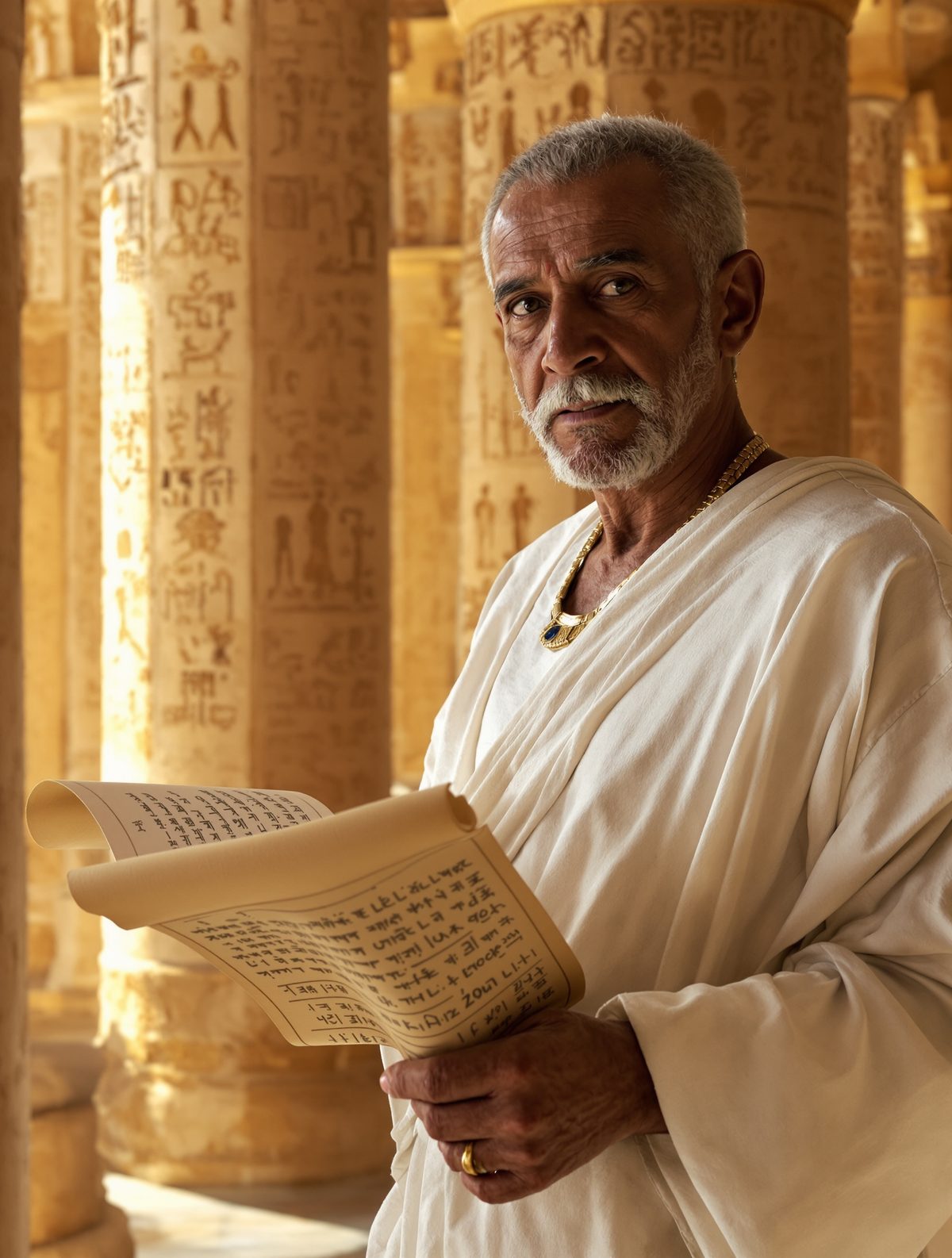
Manetho wasn't just any priest. As high priest of Heliopolis, he stood at the pinnacle of Egypt's religious hierarchy, keeper of the temple archives that stretched back to the dawn of pharaonic rule. His name meant "beloved of Thoth"—the god of wisdom and writing—and he had spent decades mastering the intricate hieroglyphic texts that recorded every royal decree, every succession, every carefully buried scandal.
The temple walls around him told stories no Greek could read. Here were the true records: how the first pharaoh Menes had united Upper and Lower Egypt around 3100 BC, how the pyramid builders of the Old Kingdom had commanded armies of workers, how queen Hatshepsut had ruled as a male pharaoh for twenty-two years. These weren't just historical facts—they were sacred truths that legitimized the pharaohs' claim to divine kingship.
But by Manetho's time, the last native Egyptian pharaoh had been dead for nearly fifty years. The temples still functioned, the priests still performed their rituals, but Egypt now belonged to the Ptolemies—Greek-speaking Macedonians who ruled from the gleaming new city of Alexandria.
When Conquerors Demand the Truth
Ptolemy II Philadelphus was no ordinary foreign ruler. Unlike other conquerors who might have simply imposed their own culture, he was obsessed with knowledge. His famous Library of Alexandria was already becoming the ancient world's greatest repository of learning, and he wanted everything—including the complete, authentic history of his new kingdom.
The problem was that Egyptian history existed nowhere in Greek. The pharaohs' chronicles were locked away in hieroglyphic temple records, accessible only to priests like Manetho who had spent lifetimes learning to read them. Worse, much of this history was deliberately obscure. The Egyptians didn't write straightforward chronologies—they recorded royal years in relation to religious festivals, buried political information in ritual texts, and sometimes erased pharaohs from the record entirely when they wanted them forgotten.
So Ptolemy II made Manetho an offer he couldn't refuse: write a complete history of Egypt in Greek, and the new regime would continue supporting the temples. Refuse, and risk seeing the ancient religious establishment crumble.
The Ultimate Act of Cultural Betrayal—Or Salvation?
What Manetho produced was extraordinary: the Aegyptiaca, a comprehensive history of Egypt from the first pharaoh to the Persian conquest. But this wasn't just a simple translation. Manetho had to completely reimagine how Egyptian history could be told.
He organized Egypt's rulers into thirty dynasties—a system so logical that historians still use it today. He provided actual numbers: specific regnal years, concrete dates, precise genealogies. For the first time, someone had created a linear, chronological narrative of Egyptian kingship that outsiders could understand.
The revelations were staggering. Manetho disclosed that Egypt had been ruled by 341 pharaohs across 3,555 years (by his calculation). He revealed forgotten dynasties, explained the mysterious "intermediate periods" when central authority collapsed, and even included embarrassing episodes like the Hyksos invasion—when foreign rulers had controlled Egypt for over a century.
Most shocking of all, he exposed the carefully maintained fiction of unbroken divine kingship. Egyptian royal propaganda had always presented the pharaohs as an uninterrupted succession of god-kings. Manetho's history revealed the truth: civil wars, competing dynasties, foreign invasions, and periods when nobody was quite sure who was actually in charge.
Secrets That Changed How We See Ancient Egypt
Consider what Manetho revealed that the pharaohs had tried to hide. He disclosed that the pyramid-building Fourth Dynasty had only four pharaohs but lasted 106 years—meaning these god-kings had extraordinarily long reigns that suggested either remarkable stability or inflated record-keeping. He revealed that the Sixth Dynasty collapsed into chaos, with pharaohs reigning for mere months as the Old Kingdom disintegrated.
He told the Greeks about Hatshepsut, the female pharaoh whose successor had tried to erase her from history by chiseling her name off monuments. He explained the religious revolution of Akhenaten, who had briefly abolished Egypt's traditional gods in favor of a single solar deity—a story that had been carefully suppressed by later pharaohs who considered him a heretic.
Perhaps most remarkably, Manetho provided context for biblical stories that his Greek readers knew secondhand. His account of the Hyksos expulsion may have preserved Egyptian folk memories of the Hebrew exodus. His chronicle of foreign invasions explained how the mighty civilization that built the pyramids had eventually fallen to Persian, then Greek, then Roman control.
The Price of Preserving the Past
Manetho's Aegyptiaca survives today only in fragments, quoted by later historians like Josephus and Julius Africanus. But those fragments became the foundation of all Egyptian chronology. Every timeline of pharaohs, every museum exhibit about ancient Egypt, every documentary about the pyramids relies fundamentally on the organizational system this collaborating priest created for his foreign masters.
The irony is profound. By betraying the temples' ancient secrecy, Manetho ensured that Egyptian history would survive the death of Egyptian civilization. The hieroglyphic records he translated were eventually lost or became unreadable when knowledge of the script disappeared. But his Greek text was copied and preserved, carrying the pharaohs' stories across centuries and continents.
Yet something essential was lost in translation. Manetho's systematic chronology, so useful to modern historians, stripped away the mythic, cyclical understanding of time that had defined Egyptian culture. The pharaohs became historical figures rather than living gods. Egypt became a conquered province with an interesting past rather than the eternal kingdom at the center of the world.
Today, as we digitize indigenous knowledge systems and debate who owns cultural heritage, Manetho's dilemma feels remarkably contemporary. He faced an impossible choice: let his civilization's history die with its culture, or preserve it in a form that fundamentally transformed its meaning. He chose preservation—and in doing so, became both the savior and the gravedigger of pharaonic Egypt. Sometimes the greatest betrayals and the greatest acts of salvation are indistinguishable, separated only by the passage of time and the judgment of history.